Whoa,LA

Yesterday, I saw a billboard on the NJ Turnpike:

Forever New Orleans

Open to Just About Anything

Road trip!

Actually, it’s not much of a trip: we have a conference in NYC this week, so I’ll be staying at a little hotel near Times Square for the next couple of nights. Since the exhibit hall doesn’t open till 10am, I should have a little time for blogging in the morning. On the other hand, we’ll also be taking clients out for dinner, etc., so I may be in no shape to write in the morning.

Don’t expect so much outta me, okay?

Monday Morning Montaigne: Of Democritus and Heraclitus

Fortunately, you don’t need to know anything about Democritus or Heraclitus to enjoy this brief essay. (Yeah, “enjoy”. I know most of you dear readers don’t care for this project, but I’m sticking with it, because I’m finding all sorts of grist for my mill in it. Nyeh!) It begins with Montaigne explaining what he’s actually doing with these essays. See, he admits that he doesn’t know a ton about a lot of subjects, but insists on testing (essaying) them, as much to learn about himself as to learn about them:

I take the first subject that chance offers. They are all equally good to me. And I never plan to develop them completely. For I do not see the whole of anything; nor do those who promise to show it to us.

M. looks to be setting us up for that Socratic paralysis (aporia) that leads to some sorta wisdom, but he veers off course when he writes about the individuality of minds:

Death is frightful to Cicero, desirable to Cato, a matter of indifference to Socrates. Health, conscience, authority, knowledge, riches, beauty, and their opposites — all are stripped on entry and receive from the soul new clothing, and the coloring that she chooses [. . .] and which each individual soul chooses [. . .] Let us no longer make the external qualities of things our excuse; it is up to us to reckon them as we will.

What I’m getting out of this is that the pursuit of Truth is fine, but it’s a different project than understanding the vagaries of the human soul. And when it comes to that soul, we need to be aware of the lows as well as the highs:

Every movement reveals us. That same mind of Caesar’s which shows itself in ordering and directing the battle of Pharsalia, shows itself also in arranging idle and amorous affairs. We judge a horse not only by seeing him handled on a racecourse, but also by seeing him walk, and even by seeing him resting in the stable. [. . .] Each particle, each occupation, of a man betrays him and reveals him just as well as any other.

“Every movement reveals us.” Most religions feature an afterlife in which judgment gets passed on the dead, all of their deeds and thoughts recorded on a ledger, held to account. For M., we go in the other direction, extrapolating the soul from a single fragment. For those of us who consider our lives to be tangles of contradictions, this is a strange notion, but maybe M.’s telling us that we don’t have the perspective to understand what seems inexplicable to us about ourselves.

In his essays, M. quotes liberally from Cicero, Plutarch, Virgil and others. From me, you get the Coen brothers:

It’s like pulling away from the maze. While you’re in the maze, you go through willy-nilly, turning where you think you have to turn, banging into the dead ends, one thing after another.

But you get some distance on it, and all those twists and turns, why, they’re the shape of your life. It’s hard to explain. But seeing it whole gives you some peace.

–“The Man Who Wasn’t There”

When M. finally gets to the Democritus/Heraclitus comparison, it’s merely to ask what’s better: to laugh at the “vain and ridiculous condition of man” or to lament and pity it. He sides with the former, figuring that laughter shows more disdain for mankind, while pity gives it some esteem: “We are not so full of evil as of inanity; we are not as wretched as we are worthless.”

I’ll let you know when I figure out what his concept of redemption is. If you’ve read this far, why don’t you leave a comment about what yours is?

Flat Panels, Cratering Sales

Here’s an article from BW about how Wal-Mart’s flat-panel TV pricing for the 2006 holidays helped destroy a number of electronics stores. Looks like the chain’s decision to sell a 42-inch Panasonic for under $1,000 sent its (partial) competitors off a price-war cliff:

Along with Wal-Mart’s determination to lower prices, two other factors played key roles in last winter’s 40%-to-50% flat-panel price drop and the ensuing turmoil. For one, many more retailers such as Sears and CompUSA were starting to stock a wider selection of flat-panel TVs after seeing demand soar over the previous two years. Also, manufacturers like Samsung, Sony, Panasonic, and Westinghouse had ramped up production last year with new factories in Asia and the U.S. They began flooding the market with new TVs in the latter half of 2006. All these forces combined to make a commodity of what just six months earlier had been a solidly high-end, high-margin entertainment product. “It’s Econ 101: Best Buy and Circuit City had seen fat margins from flat-panel TVs for a while, and as it happens with any product, eventually the margins come down and the music stops,” says David Abella, a portfolio manager at New York-based Rochdale Investment Management, with assets of $2 billion.

Wal-Mart is the second-largest electronics retailer today, behind Best Buy, which has fared relatively well compared to many of its rivals. But it has done so by imitating some of Wal-Mart’s best practices, most notably an efficient supply chain, by the admission of CEO Brad Anderson himself. It also has more diversified merchandise than other specialty-electronics retailers.

I think the collapse of CompUSA — and maybe some of the other retailers — was also triggered by the post-holiday delay of Windows Vista and the ensuing realization that Vista wasn’t a compelling reason to buy a new computer, but that’s just my pet theory. I’m sure the demolition of flat-screen margins was the biggest factor, given the amount of floor space all of these chains devoted to those TVs. I’m fascinated by the way different sectors become commoditized.

The pharma biz, which I cover, has historically been insulated against that (until a drug’s patent life expires, that is), leading to less concern about reducing manufacturing costs. That’s changing nowadays, insofar as major companies are trying to wring excess costs out of manufacturing processes, but the market prices (and the high cost of regulatory compliance) still insulate them.

Home Improvement

Not much blogging this weekend, dear readers, between the NBA playoffs (I only watched two full games, and bits of two others) and our repainting of the guest bedroom. It’ll look awfully nice when complete (Amy gets to blog about it and post the pix), so any of you who come to visit and get completely trashed will have a nice room to crash in! Yay!

Room-painting soundtrack thus far (I’m treading on Mad Mix territory here, but hey):

Night and Day – Joe Jackson

Simple Things – Zero 7

Lexicon of Love – ABC

Mind How You Go – Skye

Ray of Light – Madonna

Ta-Dah – Scissor Sisters

Greatest Love Songs – Tom Jones

The Wild, the Innocent & the E Street Shuffle – Bruce Springsteen

Amazingly, we’re not painting the room in glitter.

Two words: Play offs

It’s NBA Playoff time, dear readers! There’s no chance on earth that the early games will be as exciting as last year’s, but that’s no reason not to watch!

To help you along, I offer up the inaugural Official VM NBA Playoff Preview! With commentary and predictions from a truly bizarre array of people, journalists (Mitchell Prothero and Tom Spurgeon), a law professor and author (Thane Rosenbaum), and some average schmoes (me, my brother, and my buddy Craig), this preview is bound to entertain, please, and provide no useful information for gambling!

So check it out and leave us your own darn predictions in the comments! Happy hoops!

Progress, I guess

At my glamorous day job, I receive a ton of e-mail from PR firms. They pitch articles, send over news items, and announce events and new product launches. Sometimes, they enclose pictures, which is always nice; I can’t remember the last time I actually had to go to the “scanner pantry” to digitize a photo or chart.

Wading through this stuff and still being able to put out a magazine requires some heavy-duty triage. I’ve developed some techniques for clearing out a ton of these items and saving the ones that look interesting or come from firms that I know are going to give me a call two days later to ask me if I read their e-mail (note to PR staff: this is one of the most irritating things you can do).

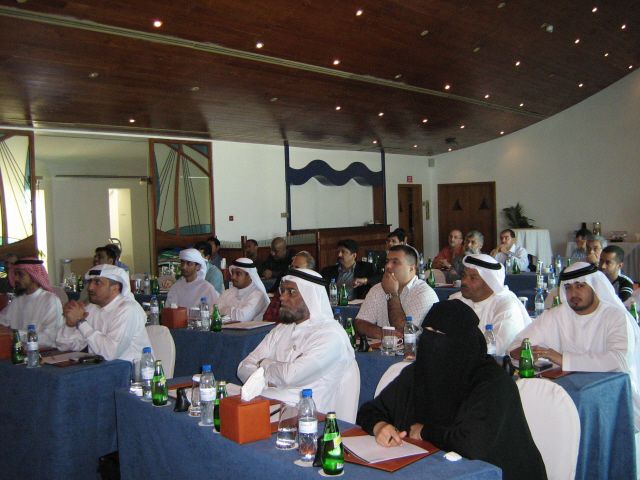
On Monday, I received an announcement about a laboratory informatics group’s upcoming software user conference in Dubai. It contained the following image from a past event:

“How progressive!” I thought. “They’re letting a ninja attend their conference!”