Episode 227 – Ben Schwartz

Virtual Memories Show 227: Ben Schwartz

“Twitter is the best source of political humor now. It’s better than any show on TV. It’s hard to compete with a million writers.”

Comedy writer, journalist and screenwriter Ben Schwartz joins the show to talk serious laughs. We discuss his work on American humor between the wars, writing for Billy Crystal on the Oscars and his contributions to David Letterman’s monologues, the profundity of Jack Benny and the importance of Bob Hope, his amazing (but unproduced) screenplay about Bob Hope and Larry Gelbart in Korea, how Jaime Hernandez’ comics prepared him to move to LA, his take on Charlie Hebdo, and what it’s like having the same name as the actor who played Jean-Ralphio on Parks & Rec! Give it a listen!

“Part of being able to sell stories is having an idea that other people don’t have, having a point of view or knowledge that other people don’t have.”

Enjoy the conversation! Then check out the archives for more great episodes!

Lots of ways to follow The Virtual Memories Show! iTunes, Twitter, Instagram, Soundcloud, Facebook, Tumblr, and RSS!

About our Guest

Ben Schwartz is a comedy writer and journalist whose work began appearing at Suck.com (as Bertolt Blecht) and has appeared since in The New Yorker, Vanity Fair, Letterman monologues, the 84th Oscars, The Baffler, The New York Times, on the radio show Wits, and with comics collaborators like Ivan Brunetti, Peter Bagge, and Drew Friedman. To what degree the work is considered journalism or satire depends on the legal circumstances of the moment and how serious your libel suit looks. He is currently on assignment for Vanity Fair and working on a history of American humor set between the two world wars, set to come out from Fantagraphics. He’s on Twitter as @benschwartzy.

Credits: This episode’s music is Nothing’s Gonna Bring Me Down by David Baerwald, used with permission from the artist. The conversation was recorded at Mr. Schwartz’s home on a pair of Blue enCORE 200 Microphones feeding into a Zoom H5 digital recorder. I recorded the intro and outro on the same equipment in a hotel room in Quincy, MA. All processing and editing done in Adobe Audition CC. Photo of Mr. Schwartz by me. It’s on my instagram.

Episode 226 – Joyce Farmer

Virtual Memories Show 226: Joyce Farmer

“The ’60s were a time of explosive interaction and learning of radical ideas. The thing was, I thought they were sensible, not radical.”

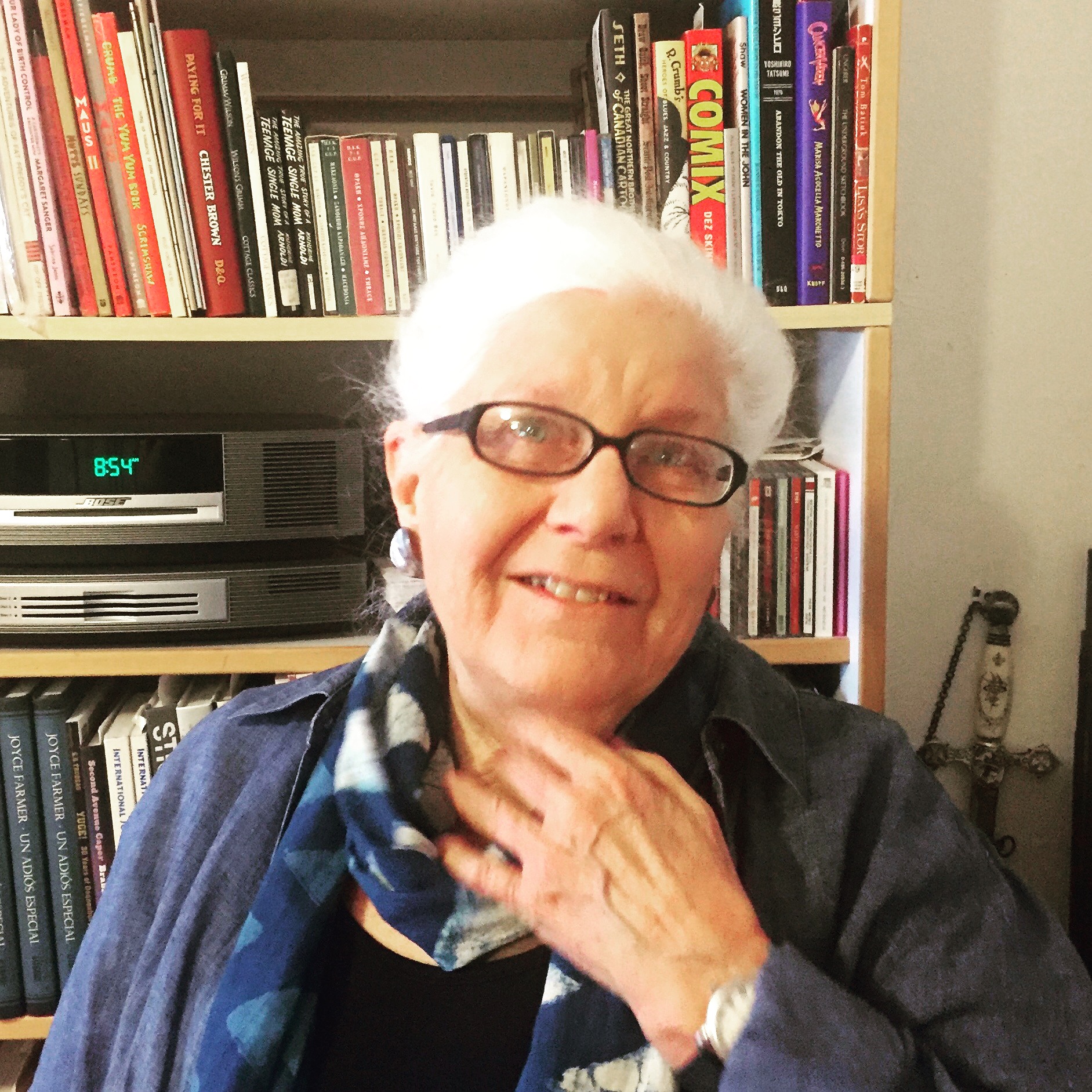
Joyce Farmer joins the show to talk about her transition from housewife to underground comics legend, the adventure of disposing of 40,000 copies of her comic when the state of California was trying to pinch her and her partner, traveling the world and landing in Greece, making Special Exits (Fantagraphics), the heartbreaking comic memoir about the death of her folks after a decade or two away from cartooning, and why she could swear and curse just as much as her male underground peers. Give it a listen! And go buy Special Exits!

“I’m not interested in doing something if it isn’t groundbreaking.”

Enjoy the conversation! Then check out the archives for more great episodes!

Lots of ways to follow The Virtual Memories Show! iTunes, Twitter, Instagram, Soundcloud, Facebook, Tumblr, and RSS!

About our Guest

Joyce Farmer, born in 1938 in Los Angeles, is a pioneering underground comics cartoonist. She and Lyn Chevli wrote and drew controversial feminist humor, starting in 1972, publishing the titles Pandora’s Box, Abortion Eve, and Tits and Clits Comix. Farmer has also been published in Wimmen’s Comix, Mama! Dramas, Itchy Planet, Energy Comics, Zero Zero, and the notorious women’s sex comic Wet Satin. Her work has been exhibited internationally, including Austria and Italy. Her most recent book is Special Exits.

Credits: This episode’s music is Nothing’s Gonna Bring Me Down by David Baerwald, used with permission from the artist. The conversation was recorded at Ms. Farmer’s house on a pair of Blue enCORE 200 Microphones feeding into a Zoom H5 digital recorder. I recorded the intro and outro on a Heil PR-40 Dynamic Studio Recording Microphone feeding into a Cloudlifter CL-1 and a Mackie Onyx Blackjack 2×2 USB Recording Interface. All processing and editing done in Adobe Audition CC. Photo of Ms. Farmer by me. It’s on my instagram.

Episode 224 – Graham Chaffee

Virtual Memories Show 224: Graham Chaffee

“What I’ve learned about storytelling is that you don’t know what the story’s about until you’re halfway through it. You might have your plot, but plot’s just the vehicle.”

Master tattooist and comics artist Graham Chaffee joins the show to talk about his new graphic noir, To Have & To Hold (Fantagraphics)! We get into the culture(s) of LA and why it’s the quintessential 20th century American city, the way the internet has changed the tattoo business, Graham’s history with comics, the difference between the story and the plot, his lengthy hiatus from making comics and what brought him back to it, the joys of drawing a good dog, the accidental portrayal of race in his comics, and the time he did a full-back tattoo portraying the dark night of Lisa Simpson’s soul! Give it a listen! And go buy To Have And To Hold (along with Graham’s other comics)! And visit his tattoo shop, Purple Panther Tattoo, when you’re in LA!

“I think the dirty, old, crappy version of things was organic, and the newer, cleaner version is manufactured.”

Enjoy the conversation! Then check out the archives for more great episodes!

Lots of ways to follow The Virtual Memories Show! iTunes, Twitter, Instagram, Soundcloud, Facebook, Tumblr, and RSS!

About our Guest

Graham Chaffee is a professional tattoo artist and cartoonist. His previous books are The Big Wheels (1993), The Most Important Thing and Other Stories (1995), and Good Dog (2013). He lives and works in Los Angeles. You can find him on instagram at graham_chaffee

Credits: This episode’s music is Nothing’s Gonna Bring Me Down by David Baerwald, used with permission from the artist. The conversation was recorded at Purple Panther Tattoos on a pair of Blue enCORE 200 Microphones feeding into a Zoom H5 digital recorder. I recorded the intro and outro on a Heil PR-40 Dynamic Studio Recording Microphone feeding into a Cloudlifter CL-1 and a Mackie Onyx Blackjack 2×2 USB Recording Interface. All processing and editing done in Adobe Audition CC. Photos of Graham by me. They’re on my instagram.

Episode 222 – Arnie Levin

Virtual Memories Show 222: Arnie Levin

“Don’t fraternize with inkers; they’ll always get you in trouble.”

Cartooning, illustration and animation legend Arnie Levin joins the show to recount his epic career and life. We talk about Beatnik-era New York, his mother’s decades-long plot to turn him into a New Yorker cartoonist, the value of a good art director, telling the Marines he wanted to be a photographer, his two-minute education in directing animation, what it was like to see his style copied by an artist who was previously copying another artist’s style, the time Allen Ginsberg tried to give him an iguana, and more! Give it a listen! And go check out his work at Art.com!

Enjoy the conversation! Then check out the archives for more great episodes!

Lots of ways to follow The Virtual Memories Show! iTunes, Twitter, Instagram, Soundcloud, Facebook, Tumblr, and RSS!

About our Guest

This is adapted from Richard Gehr‘s wonderful book, I Only Read It for the Cartoons: The New Yorker’s Most Brilliantly Twisted Artists:

Born in 1938, the diminutive Levin sports the shaved head, handlebar mustache, and slightly rolling gait of a badass biker. Much of his upper body is tattooed with ornate Japanese imagery by a renowned yakuza body illustrator. And the more you learn about his life, the wider the gap between creator and creations seems to spread.

Levin served in the Marines before winding up as an aspiring painter amid New York City’s late-fifties beatnik heyday. “Swept up in the glamour of the beatnik era,” as he puts it, Levin co-operated an espresso house that hosted readings by the likes of Allen Ginsberg and Jack Kerouac. He worked parties as a rent-a-beatnik, encountering Bob Dylan, another new kid in town, during one such event.

At Push Pin Studio, then at the height of its influence upon the design world, he was plucked out of the messenger pool by Milton Glaser, who recommended him to Lee Savage’s Electra Studio, famous for its forward-looking movie trailers and commercials. After leaving Electra, Levin was recruited for The New Yorker by art director Lee Lorenz in 1974.

After taking up motorcycling at age of fifty-nine, Levin celebrated his new hobby with the aforementioned flurry of tattoos. He’s given up biking in the interests of personal safety, however, and now resides more or less quietly on Long Island in New York with his wife.

Credits: This episode’s music is Nothing’s Gonna Bring Me Down by David Baerwald, used with permission from the artist. The conversation was recorded at Arnie’s home on a pair of Blue enCORE 200 Microphones feeding into a Zoom H5 digital recorder. I recorded the intro and outro on a Heil PR-40 Dynamic Studio Recording Microphone feeding into a Cloudlifter CL-1 and a Mackie Onyx Blackjack 2×2 USB Recording Interface. All processing and editing done in Adobe Audition CC. Photo of me and Arnie by me. It’s on my instagram. Photo of Arnie’s ink by Nate Ndosi.

Episode 219 – Keiler Roberts

Virtual Memories Show 219: Keiler Roberts

“My drawing is as close as it can be to my handwriting. It’s what comes out without too much thought.”

Cartoonist Keiler Roberts joins the show to talk about her new book, Sunburning (Koyama Press). Oh, and parenthood, bipolar disorder, the avoidance of style, learning art while teaching art, making snap judgements about parents, having the world’s worst wedding photos, the temptation of shaping real life to generate a good story, trimming a 150-page memoir down to 12 pages, and why she cried when she got a blurb from Roz Chast! Give it a listen! And go buy Sunburning!

“My parenting advice is: lower your expectations for your kids and don’t make them feel special.” (I think she was joking.)

Enjoy the conversation! Then check out the archives for more great episodes!

Lots of ways to follow The Virtual Memories Show! iTunes, Twitter, Instagram, Soundcloud, Facebook, Tumblr, and RSS!

About our Guest

Keiler Roberts’ autobiographical comic series Powdered Milk has received an Ignatz Award for Outstanding Series and was included in the The Best American Comics 2016. Her work has been published in The Chicago Reader, Mutha Magazine, Nat. Brut, Darling Sleeper, Newcity, and several anthologies. Her new book is Sunburning, from Koyama Press.

Credits: This episode’s music is Nothing’s Gonna Bring Me Down by David Baerwald, used with permission from the artist. The conversation was recorded at Toronto Marriott on Bloor during TCAF 2017 weekend on a pair of Blue enCORE 200 Microphones feeding into a Zoom H5 digital recorder. I recorded the intro and outro on a Heil PR-40 Dynamic Studio Recording Microphone feeding into a Cloudlifter CL-1 and a Mackie Onyx Blackjack 2×2 USB Recording Interface. All processing and editing done in Adobe Audition CC. Photo of Keiler and Summer Pierre by me. It’s on my instagram.

Episode 218 – RO Blechman

Virtual Memories Show 218: RO Blechman

“Time may have taught me things, but I don’t think I learned anything.”

Legendary cartoonist, illustrator, animator, ad-man, artist RO Blechman joins the show to talk about his work and life. We get into the importance of play, the development of his trademark squiggly line (and how he feels when he sees it in other people’s work), his literary upbringing, his News of the Weak series of painting/collages, why he counsels against going to art school, the fateful career decision that he rues 60+ years later, his Mad Men experience and what he learned about management from running his own animation studio, the mistake of turning down a Curious George movie, creating a fore-runner of the graphic novel, and being a 2-D character in a 3-D world. Give it a listen! And go buy all his books, including Dear James: Letters to a Young Illustrator, Amadeo & Maladeo: A Musical Duet, The Juggler of Our Lady, and Talking Lines!

“I really should have been a filmmaker. I really screwed up my life in a terrible way, because I had a chance to be a full-time filmmaker and I threw it away, and it just kills me.”

Enjoy the conversation! Then check out the archives for more great episodes!

Lots of ways to follow The Virtual Memories Show! iTunes, Twitter, Instagram, Soundcloud, Facebook, Tumblr, and RSS!

About our Guest

Born Oscar Robert Blechman in 1930, RO Blechman‘s internationally acclaimed artwork spans decades, mediums, and industries. He is one of the first contemporary cartoonists to pen a full-length graphic novel with The Juggler of Our Lady in 1953, which he published after graduating from Oberlin College. His illustrations and comic strips have graced magazines, anthologies, and newspapers. He has created more than a dozen New Yorker covers. Blechman is also an animated filmmaker, and at one time owned his own animation studio, The Ink Tank. He has been awarded the Gold Medal from the Cannes Film Festival, numerous Emmy Awards, and has been nominated for a BAFTA. In 2002, the Museum of Modern Art held a retrospective of his films. He is also in the Art Directors Hall of Fame, has been an Adweek Illustrator of the Year, and is the creator of many notable advertising campaigns. Blechman is married, has two sons, and lives in Ancram, NY.

Here’s a bio of him that Edward Sorel wrote in 1999. His own version is at his site.

Credits: This episode’s music is Nothing’s Gonna Bring Me Down by David Baerwald, used with permission from the artist. The conversation was recorded at Mr. Blechman’s farm on a pair of Blue enCORE 200 Microphones feeding into a Zoom H5 digital recorder. I recorded the intro and outro on a Heil PR-40 Dynamic Studio Recording Microphone feeding into a Cloudlifter CL-1 and a Mackie Onyx Blackjack 2×2 USB Recording Interface. All processing and editing done in Adobe Audition CC. Photos of Mr. Blechman and his wife by me. It’s on my instagram.