Who am I? I’m the guy whose wife bought him The Fran Lebowitz Reader
I’m also the guy who bought her Simon Doonan’s Gay Men Don’t Get Fat
A podcast about books, art & life — not necessarily in that order
Who am I? I’m the guy whose wife bought him The Fran Lebowitz Reader
I’m also the guy who bought her Simon Doonan’s Gay Men Don’t Get Fat
Virtual Memories – season 2 episode 2
Gil Roth – Burning Libraries
Podcast: Play in new window | Download
Subscribe: Spotify | TuneIn | RSS | More
Another month, another podcast! I told you I was trying to keep to some sorta schedule for 2012, so here’s the latest installment of the Virtual Memories Podcast!
I’m still working with both mic placement and amp effects, so I apologize in advance if you’ll need to turn up the volume a little to listen to it. I really oughtta take a class in this stuff, so I can get the technical aspects down, rather than hashing this stuff out every time.
Still, it’s another podcast! Enjoy!
Follow The Virtual Memories Show on iTunes, Twitter, Facebook, Tumblr, and RSS!
Credits: music from Rome
On Friday evening, Amy was over at a neighbor’s, so I spent some time downstairs in the library, looking at my books and pulling ones that I hope to read in the year ahead. I’m going to list them here so I can check back in December and see how far I deviated from plan. Also, so I can look like a smartypants:
 – Hemingway (re-read)
 – Hemingway
 – Fitzgerald (re-read)
 – Martin Amis
 – Tibor Fischer
 – Bob Dylan (re-read)
 – Chip Kidd
 – Virgil (tr. Fitzgerald)
 – Ovid (tr. Mandelbaum)
 – Milorad Pavic
 – Keith Richards
 – Clive James (I’ve been winding my way through this for quite some time, and hope to finish it this year)
 – Evelyn Waugh
 – Anton Chekhov (tr. Pevear & Volokhonsky)
That’s only 14 books, so I’ve left myself plenty of wiggle room. I don’t think I’ll start a major reading project this year, like tackling Caro’s biography of LBJ or re-reading Proust. I’ve been thinking about re-reading Middlemarch

Virtual Memories – season 2 episode 1
Gil Roth – Pale Horses at the Burger Joint
Podcast: Play in new window | Download
Subscribe: Spotify | TuneIn | RSS | More
I managed to make it through a whole year of being 40! Today I’m turning 41 and I don’t know what to do with myself. (That sounds like a Morrissey song title.)
In honor of the new year and my new year, I recorded “season 2” of The Virtual Memories Show. I promise to get these podcasts out regularly, and to make ’em less Gil-centric than they’ve been.
I mean, not this time out, but in future. Anyway, why don’tcha download the MP3 version and listen to my conversations with myself (and a neat piece of music by Bach).
While you’re at it, why don’tcha leave a comment below about people you think I oughtta interview or topics I oughtta cover?
Follow The Virtual Memories Show on iTunes, Twitter, Facebook, Tumblr, and RSS!
Podcast: Play in new window | Download
Subscribe: Spotify | TuneIn | RSS | More
The podcast was recorded using a Blue Yeti microphone
The year began with a novel about a dying newspaper and (just about) ended with a novel about the eternal sleaziness of newspapers.
According to the list of All The Books I’ve Read, I finished 32 books in 2011; several were re-reads, one was a Kindle Single, one was a play and another was a novella. I’ve decided that my year-end post should be a look back at those books, what I made of them, how I came across them, and any other recollections or observations I can make about ’em.
First, I oughtta note that 32 books isn’t that much. I mean, all told, the Great List shows that I’ve finished around 600 books since I began keeping the list in the fall of 1989, when I started college. That puts me a little above the “average” of 27 books a year, and it sure makes me regret that 2-year run in 1997-98 when I couldn’t finished a goddamned thing. But with math like this, even if I up the pace to an even 30 books a year, there’s still no chance I’ll ever work my way through my library.
Which is why I’m glad I came across this page in Kevin Huizenga’s latest issue of Ganges last week; shows I’m not alone in thinking about The Math:

The year’s big reading project, as I wrote about earlier, was Anthony Powell’s A Dance To The Music of Time. I’d rather not write about those books individually in this post, since I’m still a bit muddled about the first half of the series. It took me a while to get into the rhythm of Powell’s writing, and I think the three WWII novels (books 7-9), plus their immediate successor (Books Do Furnish a Room), mark the high point of the cycle. But, like I said, I’m going to leave off writing about them, except in terms of where they fall in sequence, and focus on the other 20 books for this post.
Also, because of my prose-bias, I won’t go into the comics that I read over the year. However, there’s one comic I read in 2011 that trumps this entire list: Jaime Hernandez’s conclusion to The Love Bunglers, in Love & Rockets #4. I wrote about this a little during my heart scare in October, and I want to reiterate: what Jaime achieves by the end of that comic, capping off 30 years of stories of Maggie and her world, is a perfect piece of art.
On with the show:
The Imperfectionists
Shortly after finishing that book, I turned 40. I also began A Question of Upbringing
The Age of Innocence
Anyway, I loved it, thought it did a wonderful job working through the social mores of post-Civil War New York, and felt it would’ve been more awesome if Archer, at that pivotal moment, went hardcore, killed May and went on the lam with Countess Olenska in Europe. But then the book would’ve had a much different reputation. I got at least one other person to read this, and she enjoyed the heck out of it, too.
1959: The Year Everything Changed


A lot of this literary year was spent trying to get out of my own historical moment. The Powell books, of course, cover a chunk of the 20th century, and Kaplan tries to get at the ways in which 1959 shaped who we became in the succeeding decades.
Arcadia
Time’s Arrow
(I once passed on Amis’ London Fields
Slaughterhouse-Five
The Leopard
It’s “about” a prince in Palermo in the 1860s, when Italy is in the process of unification and the merchant class is on the rise. The prince understands that the nobility’s days are numbered, but must negotiate his family’s wellbeing as long as he can, while he comes to grips with the younger generation’s ascent. And he’s SO so human. Lampedusa evokes this entire world, with its nobility, its clergy, its militia, its tradesman, its upstarts, its cosmos. I hope you get to read it sometime.
Here’s what I read from it last night, before turning in:
Between the pride and intellectuality of his mother and the sensuality and irresponsibility of his father, poor Prince Fabrizio lived in perpetual discontent under his Jovelike brow, watching the ruin of his own class and his own inheritance without ever making, still less wanting to make, any move toward saving it.
A River Runs Through It
(I don’t think any book changed for me so dramatically as my 2010 reread of the Iliad
Weirdly, Maclean’s novella about fly-fishing and grace didn’t change too much for me this time around. In some respects, it’s the book that helped shepherd me along into my “boring old fart” mode. Which isn’t to say that it’s a boring book; rather, its assuredness of voice and lovely-yet-stark depictions of the lives of the two brothers and their family helped me appreciate silence and the absence of literary pyrotechnics.
(It also helped me form some sorta background for trying to understand Terence Malick’s Tree of Life. Emphasis on “trying”.)
Nemesis
What’s most interesting about this one is the narrator, who starts off as a first-plural “we,” but eventually shows up and plays a role in unspooling the later aspects of the tale. He also undercuts a lot of the simplistic thinking of the earlier pages, in a conscious reflection of the lead character’s mental limitations. It’s a neat trick, demolishing the lead’s earnestness and self-seriousness like that.
Bespoke: Savile Row Ripped and Smoothed
One of my resolutions for 2012 is to have some shirts made for me by a tailor. I have the cash to do this, but I also have a bit of anxiety about sitting down and talking about fabrics, cuts and styles with someone who knows a bazillion times more about them than I do. Of course, that’s preferable to working with a tailor who doesn’t know that stuff better than I do, but I have Novice’s Worry. I’ll tell you how it works out.
The Most Human Human: What Talking with Computers Teaches Us About What It Means to Be Alive
Everyman
Zero History
The Junket

I like the idea of Kindle Singles, in terms of being able to publish long-form (but not book-length) work at a lower price point. Non-fiction books often feel to me as though they’re padded to reach a certain page count, so I’m in favor of writers knowing when to stop.
The Leopard – I read it again, 3 months later. Still on my night-stand.
The Finkler Question
Wise Blood
Then I got a mailer from St. John’s about next year’s Piraeus continuing education program. Here’s the opening page:
The ancient port of Athens, the Piraeus, is a lively juncture of departures and homecomings. As in the days of Socrates, it represents the pulse-point of the community. A reunion, a chance encounter, a new beginning, an opportunity to reinvent one’s self — all these possibilities exist at the Piraeus.
Join Us.
St. John’s College, in cooperation with the Alumni Association, is pleased to offer Piraeus 2012, a continuing education program for alumni. We invite your participation, and we strive to awaken the curiosity that stirred Socrate to venture down to that port and led to journeys that shape our thoughts and lives today.
Among this year’s offerings? A four-day course in Annapolis on Wise Blood and six of O’Connor’s short stories, led by two of my favorite tutors (no professors at SJC) from the school. The brochure read
Flannery O’Connor’s southern gothic stories and novels have the power, character, and plot of Greek tragedy. In Wise Blood, her first novel, and these six stories, which are poignant, often hilarious, and always disturbing, her characters have life-changing experiences that raise profound questions about grace, trust and the nature of the good. O’Connor is sensitive to the appearance of spirit in the world as she pursues the meaning of life, love, and destiny. [And serial commas.] Join us in reading this singular writer, as she searches the recesses of the human heart.
Yes, that’s my idea of a great mini-vacation. (There’s also a six-day course in Santa Fe in August on Thucydides, but I doubt I could get away long enough for that.) I stopped at that new & used bookstore where bought The Finkler Question and ordered the Library of America hardcover of The Works of Flannery O’Connor
That said, it’s like shopping with one hand tied behind my back, compared to using Amazon. I get to pay full price, wait several days for the book to arrive at the shop, and then drive 15 miles each way to pick it up.
So what did I make of Wise Blood? Well, I liked it more than Norm did, and think it was a much more accurate approach to life-with-religiosity-and-without-God than The Finkler Question. Can’t wait to talk about it next May/June!
This took me into December. After I finished the last book in the Dance, I thought I’d take it easy for the rest of the year. Then Christopher Hitchens and Vaclav Havel died, and I got drawn right back into devouring books.
Scoop
In Waugh’s book, a “country life” columnist who lives in quiet seclusion (in a typically demented old money mansion) accidentally gets sent on assignment to darkest Africa to cover a civil war. When I write “darkest Africa,” I mean that Waugh comes off racist as fuck. If you can see past that, it’s a very funny novel, and Hitchens maintained that the behavior of reporters hadn’t changed in the decades since Scoop was published. Given the phone-hacking scandals embroiling Murdoch’s newspapers, we can see that the behavior just adapted for new technologies.
The Trial

I was prompted to start The Trial after I read this quote from Vaclav Havel in a New Yorker writeup:
“I am the kind of person who would not be in the least surprised if, in the very middle of my Presidency, I were to be summoned and led off to stand trial before some shadowy tribunal, or taken straight to a quarry to break rocks,” he told a startled audience at Hebrew University, in Jerusalem, less than six months after taking office. “Nor would I be surprised if I were to suddenly hear the reveille and wake up in my prison cell, and then, with great bemusement, proceed to tell my fellow-prisoners everything that had happened to me in the past six months. The lower I am, the more proper my place seems; and the higher I am the stronger my suspicion is that there has been some mistake.”
As someone who’s always considered himself a fraud and is so convinced that he’s going to be ground down by larger forces that he’s saved them the trouble by grinding himself down, I appreciated Havel’s position. What I didn’t get from past readings of shorter Kafka (A Hunger Artist, The Metamorphosis, et al.) was the sheer humor of his writing. Midway through The Trial, I thought, “Charlie Kaufman’s screenplays make so much more sense now.”
Sure, The Trial is an “unfinished” novel, just like The Castle
Hitch-22
The book is written more loosely than Hitchens’ columns and book reviews. There’s more personal flair, more impression, more “I guess you had to be there”, less argumentation and less circumspection to the prose. It’s a refreshing style for the man who’s final essay collection is entitled Arguably
The exception is the Iraq chapter, in which he brings his journalistic instincts to bear, likely to try to counter the impression that he was wrong about the invasion. He admits to not even thinking that the logistics of the post-war planning parameters, implications and possibilities would be so bungled by the Bush administration, and stands by his notion that it was correct to take Saddam Hussein out of power.
What I wonder about, and what I don’t think he wanted to address, was whether it would have been possible for this to be done “cleanly.” Just as he came around to understand that Stalinism was not an accident but a necessary result of Communism, is it true that any “regime change” operation by an outside power is necessarily going to become a godawful mess like we have in Iraq and Afghanistan? (The latter being more justifiable, since there wasn’t a real regime to change anyway.) Was it in the nature of Hitchens’ Trotskyism to believe in the viability of “imperialism for democracy”? I wish he’d have gone into this, because I do believe that the “Arab Spring” doesn’t happen without people seeing Hussein dragged out of a spider-hole and brought to “justice.” (Hitch-22 was written before aforementioned “Arab Spring,” of course.) But I also believe that other dictators saw that and doubled down on their own repressive forces, to try to keep such a thing from ever happening to them.
ANYWAY: outside of that chapter, I thought the book was fantastic. I enjoyed the literary scenesterism, the parlor games with Amis, Rushdie, Fenton and the like. The chapter about his late (1988) discovery of his Jewish roots was fascinating, inasmuch as he found himself somehow adopting Jewishness as a tenacious culture while remaining atheist and contending that Israel is essentially an outlaw state. (Which returns to those issues of religiosity, God/godlessness, and ethics, via Wise Blood and The Finkler Question, but in yet another direction.) I’m simplifying, but he doesn’t exactly get into the question of where Jews were supposed to go after the war. Except for the part about how Jews were co-opted into the ethnic cleansing practices of post-war Poland.
I found myself quite sad by the time I finished Hitch-22 (and this year), rent by the fragility of life, the voices that are stilled, the books left unwritten, the books left unread. I haven’t made any firm reading plans for 2012, certainly not on the scale of that Powell project, but I’m confident I’ll come up with something.
I hope you enjoyed this rambling recap, dear reader. I have a mild interest in other fields (sports, menswear, technology) but really, the only question I can ask to show that I care is, “What are you reading?”
I haven’t posted a new Overheard in Dunkin’ Donuts in a long-ass time. Is it because I make coffee at home / in the office rather than go out to get it? Is it because people are more boring than they were in the old days? Who knows? All I can say is, I was prompted to bring back that tag this morning after I noticed this poster up in a DD near my office:

Yeah. A poster from Michael Jordan’s baseball-playing days, which were c.1994, long before this DD was even built.
I, um, wow . . .
I was pretty saddened yesterday by the news of Christopher Hitchens’ death. The inevitability of his cancer diagnosis meant it was a matter of short time, but the lucidity and intelligence of his subsequent writings must have left me optimistic that he’d recover.
I’m going to read some of his literary reviews and essays this weekend, and perhaps take up some of the novels and poems that he recommended, like Evelyn Waugh’s Scoop
Here’s his lengthy take on Anthony Powell and the Dance (with spoliers). I haven’t found any review or comment by him on The Leopard, but I’ll post if I do.
At the end of this long-ass post is the brief tale of the one time I bumped into Mr. Hitchens.
I first encountered A Dance To The Music Of Time in the mid-’90’s. A Borders bookstore had opened at the West Belt Mall in Wayne, NJ, and as was my wont, I inspected the fiction section — or was it “literature”?
At the time, my points of reference were the beginning of the G’s, where I’d look for Williams Gaddis and Gass, as well as David Gates, and the late P’s, where I’d check the selection of books by Richard Powers and Thomas Pynchon. It was in the latter section that I discovered Anthony Powell. University of Chicago Press had recently released a four-volume, slipcased edition of A Dance To The Music Of Time.
In college, I focused on “the encyclopedic novel” for my literature degree. I had a vague idea of what that term meant, and wound up conflating it with “really long novels with which I could impress/cow my contemporaries.” As such, this 12-novel cycle looked like it was right up my alley. Still, I’d never heard of Powell and the internet in that period wasn’t as awash in fan pages for obscure artists as it is today.
Further, I don’t recall there being any “flap copy” or anything else involving a plot description on the slipcase, which was shrink-wrapped to prohibit singleton sales. So I had nothing to go by, in terms of knowing what this series was about. The case was adorned with Poussin’s eponymous painting of the Dance, and the spine of each volume was a detail of one or another face of the dancers. I knew nothing of Poussin back then, still a year away from reading Arcadia

Sixty or so dollars was a large sum to me in those days, so I held off on buying the Dance. It slipped off my radar shortly after. When Powell died in 2000, I read up on the Dance a little. I considered tackling the series, which is a sort of roman a clef of British literary & society life through the eyes of a crypto-Powell narrator over the span of half a century, but never got around to it. I noted at the time that it seemed like a book to tackle in my 40’s. I used to say that about Proust when I was young, but I got around to him before turning 35, and should’ve done so sooner.
It wasn’t until last December, when U of Chicago Press announced that it had released all 12 novels as e-books, that I returned to the notion of reading the Dance. Like a good drug dealer, the publisher was offering the first e-book free. I had just finished My Year Of Gin, in which I would try a bottle of a new (to me) boutique gin each month of the year. I had planned to write about the project, but both overachieved (in terms of bottles) and underachieved (in terms of coherence), and so scrapped my chronicle of the project. You can, however, find photographic evidence here:

A Dance To The Music Of Time, it seemed to me, would make for a fine followup. The two projects were of a piece with what I now realize is a life of dilettantism. Why not give my amateur passions some degree of structure by organizing them around the calendar?
And so I decided to read one book of the Dance each month throughout 2011. Besides allowing the pace to mirror the seasons themselves, around which each novel was (subtly) organized, I was also protecting myself from burnout. I know myself well enough to know how easy it would be for me to roll through 3 or 4 of the books in the first 6 weeks of the year, before allowing the distractions and derailments that characterize much of my life to lead me away.
This morning, I finished reading the last of the 12 books, Hearing Secret Harmonies
I certainly enjoyed reading the novels, and I’ll be the first to admit that Powell’s prose can be quite tortured at times. I was also amazed at the reticence to reveal anything about the narrator’s own life or feelings, to the extent that one never learns Jenkins’ children’s names nor much about the books he writes over his 70 years (his volume on Burton’s Anatomy of Melancholy
At times, the sheer volume of coincidental meetings can be maddening (coincidence being the author’s point, I know). Another type of coincidence, during a bombing raid of London, strains all credulity. But then, perhaps that’s because my own life doesn’t have much room for chance meetings nowadays. In the early books, bumping into old friends takes the place of the narrator having to commit any real activity. While the stories and the interrelations of his friends and acquaintances are engaging, I found the “autumn” novels — those covering WWII — much more entertaining, because the narrator was largely removed from his society surroundings and had to become much more of a participant in the world. Paradoxically, the level observation is much sharper in these books than the preceding ones. There’s a wonderful comedy of manners of Jenkins’ superiors at dinner, highlighting the absurdities and hierarchies of military life. (There’s also a great moment when Jenkins, who remembers everyone over the years, encounters his brigade from earlier in the war, and discovers that his old cohort has no recollection of him whatsoever.)
I think Jenkins also undergoes a maturation process during the war novels. By book 9, The Military Philosophers
As I look back over the scope of it all, a story beginning in 1920 or thereabouts, carrying on to 1971 (the year I was born, coincidentally enough), and flashing back to Jenkins’ childhood in the naughts, I’m struck by the vividness of so many minor characters. Just like life, I didn’t think much of some of them at the time and miss them now they’re gone. (Speaking of which, Powell is merciless in his characters’ ends. So many figures are simply reported dead as the years carry on. I was under the impression that the whole cycle of novels would revolve around the four schoolboys introduced in the first book, and then found myself thinking, “Well, they didn’t actually show us [x]’s body, so maybe he’s still alive and will be back in a later novel…”, as though Anthony Powell was writing The Fantastic Four or something.)
But I won’t write too much about the goings on of the Dance. I do think it comprises a wonderful tapestry of the transformation of a certain class in British society throughout the century, but it’s also the sort of thing that no one (I know) reads anymore. In harmony with my college self, that’s probably a big part of why I stuck with this project all year.
Just as Jenkins sees patterns and echoes throughout the generations (and there are plenty of echoes in the last novel), I know there are echoes of myself from that pretentious college kid to this pretentious trade magazine editor. But there are also substantial changes, both internal and external. That Borders was demolished a few years ago, before the chain itself went under. Pynchon and Powers? I don’t read them much anymore.
I’m not sure if I’ve changed all that much since beginning A Question of Upbringing
I had two missions for November: write a novel for National Novel Writing Month and grow a moustache for Movember. I failed miserably in the former (although I did write about 1500 words of something that could grow into a short story, a first chapter, or a one-act play) but succeeded wildly in the latter, proving that natural facial hair growth will always trump creativity and a sketchy work ethic.
Amy hated the ‘stache with a passion, and offered to contribute to the men’s health charity behind Movember just to get me to shave it off early. I decided to keep it for a few extra days so that she could take some pix in natural light.
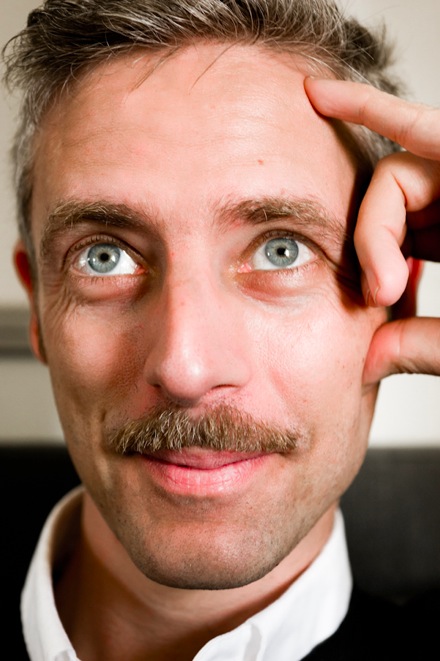
And, of course, while shaving it off, I had to try out The Hitler:

My pal Tom Spurgeon, the Comics Reporter, was visiting from New Mexico (and staying with us) this weekend to attend the Brooklyn Comics and Graphics Festival, so on Saturday I drove out to the Our Lady of Mt. Carmel Church in Williamsburg to see some cartoonists and serve as Tom’s valet. I took no pictures, so instead you get 20 quick observations/notes on the afternoon. After I shaved off the Hitler.
1. I was dressed pretty generic adult-prep at the event — white button-down oxford, black sweater, tobacco khakis — and was kinda stunned to find out that all the sartorial stereotypes about Williamsburg hipster guys were true: the trucker hats, wild facial hair, chunky eyeglasses, flannels, skintight jeans, Converse, etc. I had assumed this stuff was an exaggeration, but it was a veritable uniform for the men at the festival and in the neighborhood. I think some of the cartoonists treated me nicely because I was dressed like such a (non-ironic) square. Or an adult. Whatever.
2. The festival was just packed. I was impressed by the turnout. It’s a smaller affair than the Toronto Comic Arts Festival we attend every May, but New York paradoxically may not have the same space opportunities that Toronto has, at least for an event that doesn’t charge admission for attendees. It’s got a lot of potential, esp. with the Williamsburg art-crowd, but it’ll be tough to keep the show from getting too crowded.
3. I was awfully darned happy to get to chat with Drew Friedman, whose work I’ve enjoyed for about 20 years. He turned out to be a really pleasant guy, and liked the stylish business card my wife got me for my 40th birthday. I gave him the card so he could spell my 3-letter name correctly in the copy of Too Soon?

4. Earlier in the day, I discovered a great Gary Panter rarity, a cardboard-bound proto-collection of his Jimbo comics
5. I turned from one table and literally bumped into Matt Groening, who was at the festival with his son Abe. He may be the highest net worth individual to whom I’ve ever said, “Pardon me.” I’m pretty sure some of my friends would have simply fainted dead away upon meeting Mr. Groening.
6. I had a mind-blowingly good tongue burrito at Yola’s Cafe on Metropolitan Ave.
7. I wanted to pick up some original art from the Scott Eder Gallery table, but wasn’t inclined to spend in excess of $2,000 for a Jim Woodring page. (The “Matt Groening’s here!” prices, as one wag put it.) I ended up buying a partially inked sketch by Al Columbia and a set of 4 silkscreen prints of Woodring’s stuff. It was a lot cheaper. Multiple people warned me against showing the art to Al Columbia when he was signing at the Fantagraphics table later in the evening, for fear that he would take it from me and rip it to shreds. When I saw Al at the table, I realized they were right to worry. This is what I bought:

8. I bought the new Gloria Badcock comic from Maurice Vellekoop, because he’s a hoot. He also loved my business card and asked to keep it.
9. I walked over to Union Pool to attend the Chip Kidd & David Mazzucchelli panel, but the room was way overfilled, with attendees milling outside in the bar’s courtyard, way out of earshot. I was bummed. Later in the day, I bumped into Chip and had a pleasant conversation. We have a mutual friend in Samuel Delany, so I established my not-just-a-fanboy bona fides. We talked about his work, the panel earlier in the day, comics in general, and Delany’s health. I told him that I wanted to bring my copy of The Learners
10. The BQE separated the church (where the festival was) from the Union Pool bar (where the panels were). The city noise was kinda exaggerated by the volume of cars zooming by overhead.
11. I bought the new Kramers Ergot anthology. I thought about getting each of the contributors to sign/sketch it, because they were all on hand, but I didn’t know many of them by name or work, and thought it would be rude to say, “Don’t know you, don’t know you, don’t know you, don’t — Oh! Hey! Sammy Harkham! What are you doing out on shabbat?” And in a church, no less!
12. I got to meet Jeff Wong, who drew the cover for Tom’s book on Stan Lee
13. Like all artists, cartoonists really do like to receive praise for their work. I (briefly) interrupted R. Sikoryak’s conversation with a couple to let him know how much I enjoyed his Masterpiece Comics
14. I hoped that the Drawn & Quarterly table would be able to replace a recent issue of the Acme Novelty Library that had been misprinted, but they didn’t have it in stock. They promised to send a replacement. When I tried reading the book 2 years ago, I thought perhaps Chris Ware was engaging in some post-modern storytelling wackiness by running the last 12 pages of the book twice, but concluded that the printer/binder just screwed up. It was almost as bad as when I started reading a Xerox preview of The Birth Caul
15. Near the end of the evening, I caught up with Gary Groth at the Fantagraphics table. We spoke briefly a few nights earlier, at an event at The Strand honoring legendary cartoonist Jack Davis (Fantagraphics just published a retrospective of Davis’ career

16. I found street parking right around the corner from the festival, which made up for my getting raped by bridge-tolls: $12 at the GW, $6.50 each way on the Triborough. The Triborough really is an amazing bridge. Robert Moses sure had a heck of a vision for New York City. (You can be wrong and still have a vision.)
17. Tom moderated a conversation with Brian Ralph and CF, neither of whose work I’d read before. I took Tom out for dinner before the panel, where he worked on his questions, and then dropped him at Union Pool while I took our stuff back to the car. I thought that the panel would be more sparsely attended than the Kidd/Mazzucchelli one from a few hours before, since it was the last one of the day, but it was packed, with people spilling out of the room and into the courtyard. So I sat in the bar, had a Plymouth & tonic, and wrote for a little bit.
18. There were 3 women at the table behind me, arguing about whether one of them knew she was hot and was just downplaying it. One said, “Screw you! You don’t go to a comics festival in a kimono and thigh-highs if you don’t think you’re hot!” I was puzzled because, when I walked past the table on my way in, I reflexively noted that none of them were hot.
19. A woman standing by my table looked at me like she was about to say something, then stopped. I asked her if I knew her. She said she thought I was someone else. “The mayor of Chicago?” I asked. “Because I got that last week.” She didn’t see any resemblance between me and Rahm Emanuel. I admitted it was puzzling. She sat down at my table and we chatted for a big about cartooning. She gave me her new photcopied 8-page comic, presumably because I told her I was here with Tom.
20. Lots of people give Tom their comics. We joked about the “Comics Reporter sales bump” and thought about designing a stamp, a la Oprah’s book club, for the CR Seal of Approval. After his panel, Tom made his round of goodbyes back at the festival, and we headed back to NJ. The drive home was smooth, and I was glad to escape the constant vibration of the city. I’m afraid I’m a little out of tune.
I’m the guy whose idea of a good getaway vacation is spending 4 days in May/June in Annapolis discussing the work of Flannery O’Connor.
Anyone with me?