Virtual Memories Show #161:
Dan Perkins (Tom Tomorrow) LIVE + #NJPoet’s Corner
Podcast: Play in new window | Download
Subscribe: Spotify | TuneIn | RSS | More
“Satire is the art of exaggerating for humorous emphasis and to make a point, but how do you exaggerate Trump?”
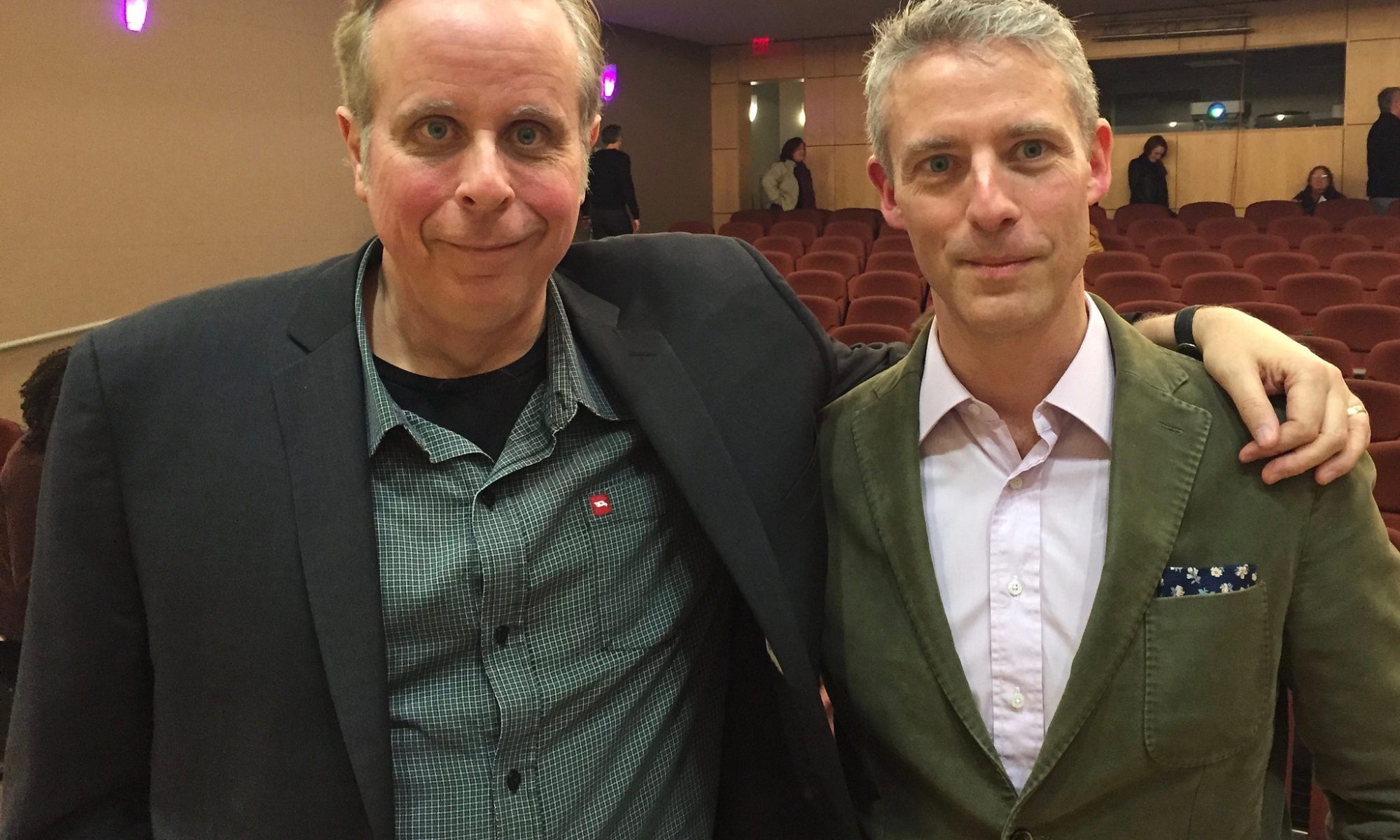
Last July, I talked to Dan Perkins (aka Tom Tomorrow) as he was launching a Kickstarter to produce 25 Years of Tomorrow, a massive quarter-century collection of his This Modern World comic strip. It was way more successful than he anticipated (356% overfunded!), so at his book launch party at Mark Twain House in March, we recorded an on-stage followup conversation, plus audience Q&A! Give it a listen! And buy 25 Years of Tomorrow!
“Does political humor date? Sure, but I was writing about gun control and healthcare reform 25 years ago.”
 Dan & I talk about the challenge of satire in this day and age, the benefits of operating under a pseudonym, the ways his life and work have changed as a result of the Kickstarter process, the ongoing labor of his production partners, Topatoco and Make That Thing!, looking back at 25 Years of Tomorrow, the mixed blessing of the internet, the doors that opened when he published a 1,000-page collection, whose hatred cheers him the most, why the internet is like Soylent Green, and more! Go listen and then order a copy of 25 Years of Tomorrow!
“It’s all fun and games until the crazy man is in the Oval Office.”

This episode is also the launch of our new monthly feature, #NJPoet’s Corner, where we’ll talk with philosopher-historian-zen-monk-poet Charles Bivona! (That starts around the 50:00 mark)
Podcast: Play in new window | Download
Subscribe: Spotify | TuneIn | RSS | More
Also, if you want to find out who Dan and Chuck are reading nowadays and get a list of the books we talked about in this episode, join our Patreon and become a monthly contributor to The Virtual Memories Show! At the end of March, the new episode of our patron-only podcast, Fear of a Square Planet, will go up with a bonus segment about who they’re reading and why.
Enjoy the conversation! Then check out the archives for more great episodes! You might like:
Follow The Virtual Memories Show on iTunes, Twitter, Facebook, Tumblr, and RSS!
About our Guest
Dan Perkins, better known as Tom Tomorrow, is the creator of the weekly political cartoon, This Modern World, which appears in approximately 80 newspapers across the U.S., and on websites such as Daily Kos, and The Nation. His work has appeared in publications including The New York Times, The New Yorker, Spin, Mother Jones, Esquire, The Economist, The Nation, U.S. News and World Report, and The American Prospect, and has been featured on Countdown with Keith Olbermann. In 2013 he was awarded the prestigious Herblock Prize in a ceremony at the Library of Congress, and in 2015 he was a finalist for the Pulitzer Prize. He received the first place Robert F. Kennedy Award for Excellence in Journalism in 1998 and 2003, and has also received the Media Alliance Meritorious Achievement Award, the James Madison Freedom of Information Award from the Society of Professional Journalists, the Professional Freedom and Responsibility Award from the Association for Education in Journalism, and the James Aronson Award for Social Justice Journalism. In 2009, he collaborated with Pearl Jam to create artwork for their album “Backspacer“. Dan has published 9 anthologies of his work, and one mega-sized 15-pound, two-volume slipcased edition of 25 Years of Tomorrow.
Credits: This episode’s music is Nothing’s Gonna Bring Me Down by David Baerwald, used with permission of the artist. The conversation was recorded at the Mark Twain House. I recorded the intro and outro on a Blue enCORE 200 microphone


 ! We discuss the societal bias against aging, what she learned by dyeing her hair gray, the decision to “self”-publish This Chair Rocks, why she doesn’t want to think about writing another book for at least a decade, the potentials of an all-age-friendly world, and more!
  and referred to by Alan Kay as “the first piece of digital “content” worth criticizing”; and the first electronic books — Douglas Adams’ Hitchhikers Trilogy and Martin Gardner’s Annotated Alice in 1992. After that there were a bunch of years spent on tool-making and in 2004 the Macarthur Foundation gave me a huge five-year grant to explore the question of what might happen to publishing in the internet era. with that grant I started
  , was published by HarperCollins in 1997. Ms. magazine called it “rocket fuel for launching new lives,” and it landed me on Phyllis Schlafly’s Eagle Forum enemies list. It also got me invited to join the board of the nascent Council on Contemporary Families, a group of distinguished family scholars. I belonged to the Artist’s Network of Refuse & Resist group that originated the anti-Iraq-invasion slogan and performance pieces titled “Our Grief is Not a Cry for War.” As a contributing editor of IEEE Spectrum magazine, I went to Laos to cover a village getting internet access via a bicycle-powered computer. Since 2000 I’ve been on staff at the American Museum of Natural History, where I write about everything under the Sun. The catalyst for Cutting Loose was puzzlement: why was our notion of women’s lives after divorce (visualize depressed dame on barstool) so different from the happy and energized reality? A similar question gave rise to my new book,


 . He is the winner of the 2012 Helen and Kurt Wolff Translator’s Prize for Gerhard Meier’s
  .
.
 (Fantagraphics),
 , the Harvey Award-nominated cutting-edge comix anthology series. His solo books include
  and
and  – underground urban comix that capture the intense, gritty underbelly of streetlife. Head was a frequent contributor to the Fantagraphics’ comix anthology quarterly Zero Zero. The Simon & Schuster’s comic book anthology
  featured Glenn’s work – a collection of personal stories depicting teenage angst. His project, Head Shots, a sketchbook of cartoon art, followed. From 2005 to 2010 Glenn edited and contributed to the Harvey and Eisner-nominated anthology
  (three issues). Over the past six years Glenn created his graphic epic,