
This is a month late. I’m just crazy over-worked, although that didn’t stop me from reading 50 books last year, or another 6 in the first month of 2016. So maybe it was more a function of anxiety than actual work-stress. Like you care.
The list below only includes prose works, not comics. I did read a bunch of good comics in 2015, like Invisible Ink , The Story of My Tits
 , and Soldier’s Heart
 (although there’s a prose Soldier’s Heart on the list). In The Guest List episode of the podcast, I talked about my favorite books from the past year, which are echoed below: I loved me some James Merrill and some Houdini.
I didn’t make any book-resolutions in last year’s edition of this writeup. I’m not sure I’ll be able to get ahead enough with the podcast and work to be able to tackle much “extracurricular” reading, but I hope to find time for The Radetzky March , The Master and Margarita
 , and Waugh’s Sword of Honour Trilogy
 . Thanks for reading.
Oh, and a few of the books I read were on my Kindle, so they’re not in The Big Stack picture above). Otherwise, that’s every book that I read in 2015.
All photos by Amy Roth Photo.
Note: (r) means it’s a re-read.
* * *

How to Live: Or A Life of Montaigne in One Question and Twenty Attempts at an Answer – Sarah Bakewell – podcast coming someday! – I kicked off the year with this biography of Montaigne, and read another one later in the year (by Stefan Zweig) this one was better. Bakewell manages to tell the story of Montaigne’s life and times, explore how they inform his Essays, and show how the Essays themselves help us understand what it means to be alive (that is, How To live). Longtime readers know I’m a big mark for Montaigne, having spent a few years working my way through the Essays from beginning to end for a blog-project, so I’m biased here, but I greatly enjoyed revisiting Montaigne through Bakewell’s book.
Third Rail – Rory Flynn – Listen to our podcast – This is the first of a series of crime novels by a pseudonymized Stona Fitch. Last year, I read two of Stona’s novels, including a really horrifying book called Senseless. I was glad to find that this one didn’t contain any of the graphic torture that Stona deployed in the earlier work. It’s an entertaining novel about an overeducated (as in Harvard) cop working in a Boston suburb. He gets enmeshed in a plot around a high-powered designer drug at the same time that his dissipation leads to him losing his gun. It’s tense, it’s noir, it’s well-written, and it doesn’t include a scene with a guy getting his fingers ground down with a cheese-grater, so bonus!
Unreliable Memoirs – Clive James – Listen to our podcast – Clive James is a treasure, and here’s where he starts telling the semi-fictive story of his life. James’ writing is alternately joyful, hilarious, and heartbreaking. This one covers his childhood, the loss of his father (MIA/POW in WWII, then killed when the plane bringing him home from the war crashed), his early education, and his departure for England. I read it (and vols. 2-4) in a hurry while preparing for a podcast with James, but I savored the humor and the lovingly detailed (and again, possibly fictive) memories of growing up in Australia in the 40s & 50s.
Happy are the Happy – Yasmina Reza – Listen to our podcast – A funny, brief novel about a string of people in Paris. Each narrates in the first person, and talks about other characters, all of whom come into their own. It’s a world of ennui and some sadness, and the only truly happy character is psychotic. It reinforced my belief that everyone in France is polygamous, but that’s probably just wishful thinking on my part.
The Tourmaline – Paul Park – podcast coming someday! – This is the second volume in a 4-book series about a political & magical battle on an alternate earth. I enjoyed the story through this point, but I’m embarrassed to say I never got through vol. 3, so I don’t want to say too much about this one. I’ll go back and read the whole shebang this spring, I hope. Part of my vol. 3 derailment was due to reading it on a Kindle, so I bought a hard copy at World Fantasy Con last fall.
Reading Dante: From Here to Eternity – Prue Shaw – Listen to our podcast – I’m really thankful that I finally got to read Dante in 2014. Also, embarrassed that it took me so long. This book, an exploration of the Commedia by Prue Shaw (wife of Clive James, who recently completed a translation of Dante), is organized along a series of themes — Friendship, Power, Life, Love, Time, Numbers and Words — and manages to interweave the work with Dante’s life, illuminating both of them in the process. Since I read the Commedia relatively recently, I’m not sure how useful a book it would be for those who have never picked up Dante, but I felt that it explained what makes Dante’s work immortal without putting undue pressure on the reader. That is, Shaw helps keep the Commedia from being too intimidating, and the biographical elements help to humanize Dante the poet (maybe a little in contrast with Dante the narrator).
Gamify Your Classroom: A Field Guide to Game-Based Learning (New Literacies and Digital Epistemologies) – Matthew Farber – Listen to our podcast – The author & I went to high school together, and I thought it’d be neat to do a podcast with him about his new book on game-based learning models. So, not a novel or a biography, but an interesting examination of how games — in all their incarnations — can help students learn to think. Back in middle school, I figured out how the “stock trading” simulation could be gamed by focusing on penny stocks, dumping them when they increased in volume and investing at the bottom of the market repeatedly. At the end of a period, while other students had moderate gains or losses, my account would have to be represented in exponential numbers (this was the early ‘80s, when the school computers’ programs ran on audio cassette). So I’ve always been sensitive to the notion of “gaming” systems and creating perverse incentives based on rules. However, Matt’s work is more about collaborative learning/play, and if I had kids, I’d be glad to use this sorta model to get ‘em learning. Good thing I don’t have kids.
La Ronde – Arthur Schniztler – When I was reading Happy Are The Happy, the press material mentioned that it was reminiscent of or inspired by this play by Schnitzler. When I mentioned that to the author during our interview, she said it was completely untrue. Still, I’m glad I read it. It consists of ten scenes, each one basically passing the baton along from one character to the next, creating a big ol’ chain of sex and class. It was written in 1897 and apparently not staged for more than 20 years, because people weren’t ready for the notion that people like to have sex.
Poetry Notebook: Reflections on the Intensity of Language – Clive James – Listen to our podcast – This is a collection of James’ recent writing on poetry. As someone who’s a bit of a poetry moron, I enjoyed it immensely, in part for the same reasons I enjoyed Prue Shaw’s book on Dante: he keeps the poetry from being intimidating. (As opposed to the Harold Bloom book I read near the end of the year, The Daemon Knows, where his chapter on Emily Dickinson left me baffled and holding on for dear life). I’d read some of these pieces when they were being published, but it’s always great to have a collection of James’ work at your fingertips. The essay on Robert Frost is worth the price of admission by itself.
Falling Towards England / May Week Was In June
 – Clive James • Listen to our podcast – Two more Clive James memoirs (like I said, I was prepping somewhat frantically; it turned out to be a great podcast!). Falling Towards England covers his years trying to get a job in England, and May Week Was In June goes into his time at Cambridge, as an older undergrad. I found these more entertaining than the first volume, because the stakes get higher (jobs, education, getting married) than the childhood hijinks of James’ early days. Plus, I’m fascinated by the way people find themselves in certain careers, as well as the paths they take that dead-end on them. There’s plenty of pseudonyms to be had in both volumes, but I didn’t find it too critical to know who people “really” were.
The Third Man – Graham Greene – I read this novella on a train from London to Cambridge, after picking it up at Hatchards in Piccadilly. I love the movie (having only discovered it 6-7 years ago), which makes it tough for me to assess the book on its own. It’s inescapable to note the changes that were made from prose to film, and whether they worked. Making Martins & Lime American and not British, for example, was an improvement, I think. Making Martins less emotional and broken-up over Lime’s death also tightened the story. And, of course, the book doesn’t include the great “cuckoo clock” speech, which Orson Welles wrote himself. So, it was an enjoyable and interesting read, in the sense of seeing what the raw material was, and how it would get transformed into a classic movie.
Lost in the Meritocracy: The Undereducation of an Overachiever – Walter Kirn – Listen to our podcast – After Clive James’ Cambridge experience, I delved into Walter Kirn’s Princeton experience (also for a podcast). Kirn portrays himself as a fish-out-of-water in an Ivy League school, unprepared for both the education and the culture. Rather than “apply himself” to literary studies, he becomes a student of cynical obsequy, figuring out how to fit in as a disaffected contrarian. His youthful model of scoring brownie points morphs into something more sinister and maybe damaging. It doesn’t carry the apocalyptic heft of Blood Will Out (which I enjoyed the heck out of in 2014) or Up in the Air (a much better book than movie), but does manage to illustrate some of the lingering problems of our melting-pot notion of America.
North Face of Soho – Okay, one more Clive James memoir! I haven’t gotten around to reading the fifth one (The Blaze of Obscurity), but this one continues James’ raconteurism (?). It details post-Cambridge life, finding work as a writer, TV presenter, theater producer (sorta), as well as becoming a father. It felt a little looser and snippier than the earlier volumes, maybe because more recent and fresher scores to settle, but still a joy to read.
How Architecture Works: A Humanist’s Toolkit – Witold Rybczynski – Listen to our podcast – I’ve enjoyed Rybczynski’s columns on architecture for years, but the only book of his I’d read previously was a series of NYPL lectures called The Look of Architecture. This book was really useful for helping explore/explain what architecture is, how it works, and why “architecture criticism” is a doomed endeavor. (That is, as I recall, because the buildings aren’t static; they’re to be understood over a course of years, in terms of how they interact with their surroundings, how people use them, and how they age.) I think the book’s great achievement was getting me to stop bashing Frank Gehry, and to appreciate his work. Rybczynski’s section on his Grand Tour just thrilled me, but I’m a nerd for that type of tradition and connection with antiquity.
Smash Cut: A Memoir of Howard & Art & the ’70s & the ’80s – Brad Gooch – Listen to our podcast – This one’s a memoir about the author’s relationship with Howard Brookner, an artist and filmmaker who died of AIDS in 1989. I wanted to enjoy it more, and I’m still not sure what was missing from it. It’s about the NYC arts scene in the ’70s and ’80s, which is prime territory. And I’m not creeped out by the promiscuity of post-Stonewall-to-pre-AIDS New York (I published Samuel Delany’s The Mad Man), but I somehow failed to connect enough with Gooch’s narration about his life with Brookner. I have a feeling it says something about me, rather than the author, that I wanted to hear more about his struggles with religion, his work-life as a model, and the contradiction of being deeply in love with someone while both of you are sleeping around. It does capture all sorts of wonderful and grungy aspects of the time they lived in. I should note that I read a lot of it in a hotel in Vegas, so it’s possible I was a bit dissociated from my soul at the time.
In Manchuria: A Village Called Wasteland and the Transformation of Rural China – Michael Meyer – Listen to our podcast – This one opened a world up to me, namely the Manchuria region of the title. The writer, an American, lived in a town called Wasteland for 3 years as it underwent an economic upheaval. Meyer does a great job of interweaving the contemporary situation in Wasteland with the history of northern China and his own story (he married a woman from Wasteland). It’s a travel narrative reminiscent of Bruce Chatwin, and it provides tremendous insights into the colonial history of the region (which helps explain aspects of Chinese behavior). Listen to our podcast!
Moral Agents: Eight Twentieth-Century American Writers – Edward Mendelson – Listen to our podcast – This is a collection of profiles of a bunch of great writers, critics, and poets from the 20th century: Lionel Trilling, Dwight Macdonald, Alfred Kazin, William Maxwell, Saul Bellow, Norman Mailer, WH Auden and Frank O’Hara (Mailer’s the only one who lived to the 21st century). Mendelson paints vivid portraits of each man, his work, and the impact he did or didn’t have on the world at large. At the same time, he dovetails the extreme personalities of these men with their work. That is, at times their striving for literary laurels seems to stem from aspects of their upbringing or lives, while at others they engage in (usually sexual) behavior that feels like an acting-out, or a desire to subvert their own gifts. Books like this tend to make me a bit sad, because they evoke a period not that long ago when writers mattered.
How Sweet It Is! – Thane Rosenbaum – Listen to our podcast – Can one write a fun, light novel about a pair of Holocaust survivors and their son trying to function? If you’re Thane Rosenbaum, yeah. You set it in Miami in 1972, populate it with the various celebs from that time — Jackie Gleason, Meyer Lansky, Sinatra, Ali, I.B. Singer, Bullet Bob Hayes and more — and tie it into the historical moment — two presidential conventions and the Munich massacre — and you’re good! It’s not as harrowing as some of Rosenbaum’s other fiction or his non-fiction, but it’s got its dark moments. It’s an affectionate reworking of Rosenbaum’s own childhood, and it’s gorgeous to see how one generation that was focused on survival has to try to show the next generation how to live.
Look Who’s Back – Timur Vermes – Listen to our podcast – I read this one to host a panel at the Goethe Institut with the author and two other speakers. Mr. Vermes’ novel is a satire in which Hitler wakes up in the middle of an abandoned lot in modern-day Berlin, with no recollection of his final days. He has to figure out what happened to Germany and how to regain power. He assumes the Russians lost because, if they’d won, they’d surely have burned all of Germany to the ground. The presence of so many Turkish restaurants makes him assume that the Turks joined to fight off Stalin’s armies. Eventually, he figures it out. The problem is, no matter how often he tells people that he’s Hitler, they assume he’s a Hitler impersonator who stays in character. He gets a TV show and tries to rally the volk, but it weirdly backfires. It’s an entertaining novel, but it also forces the/this reader to wonder when it’s okay to laugh at Hitler and when it’s okay to laugh with him. To what degree is a reader responsible for another reader’s response to a book? What about the writer’s responsibility? We talked about that a bit in our panel, which focused on the topic of satirical representations of Hitler. During the panel, I learned that people who can speak German don’t find those Downfall parodies funny. On the plus side, the German government paid me $500 to conduct a panel on when it’s okay to make fun of Hitler, which I consider a minor bit of reparations.
Chronicles – Bob Dylan (r) – This one’s a re-read, inspired by Wayne White telling me that his artist-mentor, Red Grooms, is one of Dylan’s favorite artists, as mentioned in the book. Of course, Wayne didn’t tell me that this happens about 10 pages from the end. Still, I enjoyed returning to this one, and was struck by how much it was echoed in the Coen Bros.’ movie, Inside Llewyn Davis. ILD was supposedly largely based on Dave Van Ronk’s memoir; at some point, I’ll have to check that out.
Where Women Are Kings – Christie Watson – Listen to our podcast – I didn’t dig this one too much. It’s about adoption, cultural assimilation, and maternal love, which are three things I’ve never understood (I KID!). A mixed-race couple in London adopts a 7-year-old boy of Nigerian descent who was tortured by his mentally ill mom. They try to love him, suffer the ups and downs of being parents, and then find that they’re pregnant with a child, which warps their son’s dynamic even more. It’s good material, but it felt rather staged, or mechanical, in terms of the inevitability of plot points. It’s a sad subject, and Watson to her credit doesn’t give it a happy ending, but outside of the humorous Chav supporting characters, I didn’t get too much out of this.
Muse: A novel – Jonathan Galassi – Listen to our podcast – This one’s a roman a clef about the publishing industry, centered on a secret held by an Elizabeth Bishop stand-in. It’s by Jonathan Galassi, the president of Farrar Straus Giroux, and the lead character is a younger, sorta idealized version of him. I mean “idealized” in that Galassi came out as gay in his 50s while the narrator is more comfortably out in his youth. I found the novel to be at its best when it’s telling tales of publishing days past. There’s also a great scene set at the Frankfurt Book Fair. Galassi takes the big creative risk of including the Bishop-esque poet’s actual poems, and I don’t think they really work. (He cuts himself some slack by making this work from the poet’s declining years.) Don’t get me wrong, it’s an entertaining work, but it’s uneven, and it posits a contemporary world where a poetry collection can change the world. Like I said in the bit on Moral Agents, I miss the days when writers had that stature, but we’re commodities now.
James Merrill: Life and Art – Langdon Hammer – Listen to our podcast – One of my favorite books this year. I didn’t have a lot of experience with Merrill’s poetry, but Langdon Hammer’s biography explore’s both JM’s life and its intersections with his poems. It’s big, but I found it compulsively readable (Hammer was a little shocked when I told him that I’d read a chapter a day in order to be ready for our podcast). What I found fascinating about Merrill wasn’t simply his poetic achievement and his Ouija-board derived major work, The Changing Light at Sandover, but the way in which someone born into huge money (his dad was co-founder of Merrill Lynch) managed to pursue his art with the discipline and rigor of a career. That is, heirs tend not to grasp the value of hard work, and JM’s life breaks that mold. Hammer manages to convey that, the poetic explication, and the singular path JM took as a wealthy, pleasure-seeking gay man in mid-century America (and Greece). This is a remarkable book, and I hope readers don’t get daunted by its size (around 800 pages), because Hammer really manages to convey the immensity of a life in a way I’ve rarely seen in print.

Orient: A Novel – Christopher Bollen – Listen to our podcast – I read a few mysteries and thrillers this year, and I think this was my fave. It’s a murder mystery taking place in a town at the end of Long Island’s North Fork. Wealthy New York artists have begun buying up homes, causing tension with the locals. A young drifter comes to live with a local, and finds himself a suspect as the murders commence. Bollen does a fantastic job of building the town and its history, but also draws sympathetic profiles of the artists who are moving in, not content to make either side a caricature. A key character gets killed pretty late in the book, in a way that’s kinda merciless, and I called Bollen out on it when we recorded our podcast, but he took it as a good sign that I cared so much for the character that the death scene bothered me.
A Hand Reached Down to Guide Me: Stories and a novella – David Gates – Listen to our podcast – I love Gates’ stories and novels, but I have a warning for readers of this one: don’t read it all at once. Space the stories out, because Gates’ tone and over-educated, self-nullifying characters can get a bit overwhelming one after another. He’s not repetitive, but it’s a type that can kinda wear thin. Or maybe I just read the collection WAY too quickly. Regardless, the centerpiece of the book is a novella that absolutely floored me, and it makes me wish Gates had another novel out, even though he’s an absolute master of the short story.
The Unfortunate Importance of Beauty: A Novel – Amanda Filipacchi – Listen to our podcast – This is one of those novels where the title is exactly what it’s about. It’s a bizarre fable/fairy tale about female beauty and men’s reaction to it. It’s ridiculously enjoyable; I picked it up at The Strand and found myself like 15 pages in, blocking traffic. There’s slapstick, there’s philosophical rumination on love and appearances, there’s a murder mystery, there’s surrealism, there’s a love story, and maybe some redemption.
Our Brothers at the Bottom of the Bottom of the Sea – Jonathan Kranz – Listen to our podcast – I never know how to write about YA novels, for obvious reasons: not my demographic, I don’t have kids, and I don’t like other people’s kids. That said, this is a pretty thoughtful, solidly written novel about a trio of mismatched, troubled teens in a New Jersey shore town that’s not quite Ocean City. If I had a teenaged kid, I’d be happy with him reading this, but I’d probably be unhappy a variety of other reasons.
Generation Loss – Elizabeth Hand – Listen to our podcast – I went into this thinking “Generation Loss” was some sort of military term, like that “Generation Kill” book. Turns out it’s a photography term, and it’s a thriller novel about a burned-out, dissolute photographer named Case Neary. She was a big deal on the punk scene 30 years earlier, and is at the end of her rope when she gets an assignment that leads her into a decades-long murder mastery in rural Maine. Hand does a great job evoking the locale, and Neary’s lack of morals make her a pretty entertaining protagonist. Not a genre I spend too much time reading, but I enjoyed it a bunch.
Available Dark – Elizabeth Hand – Listen to our podcast – This is the sequel to Generation Loss, so I was prepared for the photography-title. Cass Neary goes to Iceland partly to avoid the fallout of the previous novel’s events. This time, the murders she stumbles into are geared around photography, and the writing is even more confident than the previous Neary novel. In some respect, it’s not exactly a mystery novel, because Cass kind of gets carried along from scene to scene toward the murderer, without much reliance on her own detective activities. She’s not a detective, so it’s okay that she’s not solving everything on her own, but I would’ve liked a little more initiative on her part. That won’t stop me from reading the third Neary novel when it comes out in ’16, of course.
Soldier’s Heart: Reading Literature Through Peace and War at West Point – Elizabeth Samet – Listen to our podcast – This is a wonderful semi-memoir about being a civilian literature professor at West Point. Elizabeth Samet demolishes a lot of stereotypes about the military, showing how her course of study works to help her students (future officers) strike a balance between regimentation and creativity. The period she covers spans 9/11, and it was fascinating to see how the college, the cadets, and her role changed in response. I loved this book.
No Man’s Land: Preparing for War and Peace in Post-9/11 America – Elizabeth Samet – Listen to our podcast – Didn’t love her followup as much, probably because I read it immediately after, in preparation for our podcast. I’m sure if I read it a year or more after Soldier’s Heart, it would have stood much better on its own. Unlike that book, this one works more to tell the stories of her students in a post-9/11 world. Many of them were thrust into battle-command roles in their 20s, and by the time they were rotated out or finished their commissions, they were rendered hollow, unable to find any experience that matched the vividness of war. She also writes of the cadets who never came back from war. I mean, it’s a great topic, but the book just didn’t grab me the way her previous one did. The more I think about it for this writeup, the more I realize pieces of it keep coming back to me; I’ll likely give it a re-read in a year or two.
Mademoiselle: Coco Chanel and the Pulse of History – Rhonda K. Garelick – Listen to our podcast – Maybe it’s a sign that I’m getting old, but a bunch of my favorite books in 2015 were biographies. I didn’t know what to expect from this bio of Coco Chanel, since I only had a general knowledge of her life and her impact on women’s fashion, but I thoroughly enjoyed this book. Rhonda Garelick does a great job exploring the self-mythology of Chanel’s life, the importance of her work, how she changed the way women saw themselves, and more. The book does a great job of getting interviews with new sources, as well as explaining Chanel’s achievements in their economic context. It’s one thing to praise her work, but it’s another to show why it was unprecedented and how it required certain conditions in order to success. Also, Garelick doesn’t pull any punches when she explores Chanel’s terrible behavior during WWII, but she manages to weave that into the complex tapestry of Chanel’s life in a way that, while it’s not excusable, it is explicable. The book is also filled with photos that help the, um, visually/ladyfashion-challenged to see the innovations of Chanel’s work. Again, a person/topic I wouldn’t think I’d find so interesting, but Garelick does a fantastic job of bringing Chanel to life, in all her contradictions and complexity.
The Sex Lives of Siamese Twins: A Novel – Irvine Welsh – Listen to our podcast – This is the second Miami novel I read this year, after Thane Rosenbaum’s How Sweet It Is!. Since Irvine Welsh is Irvine Welsh, this one’s both more apocalyptic and a lot funnier. A personal trainer saves a guy who’s about to be murdered on a causeway. A chubby artist films the whole thing on her phone, making the trainer a celebrity. Until it turns out that the perp was a victim of child molestation and the guy he was going to kill was the molester from his childhood. It only gets dark a bit later, after the artist becomes infatuated with the trainer, and the trainer decides to kidnap the artist, chain her up, and force her to lose weight. It skewers the art world, the “Biggest Loser”, reality TV and celebrity in general, and does it all pretty acidly (again, Welsh being Welsh). It’s the first thing I read of his that wasn’t set in Scotland, and I was impressed at how adeptly he “wrote American.” We recorded a podcast a few weeks later and literally never mentioned this book, because I suck.
Latest Readings – Clive James – Listen to our podcast – By now, you’ve guessed that I’m a huge mark for Clive James’ work. This collection of essays covers the books he’s been reading since his health collapsed. He writes, “If you don’t know the exact moment when the lights will go out, you might as well read until they do.” And so he goes back to Joseph Conrad and discovers new depths. He returns for the bazillionth time to Anthony Powell, re-evaluates Olivia Manning’s two war trilogies, the Jack Aubrey novels, and more, in his witty, incisive manner. No, it’s not the quality of Cultural Amnesia or his other top-flight work, but it’s the sort of book that will send you scrambling to a bookstore to pick up more of the titles he writes about. For me, that’s the best kind of book there is.
Lionel Asbo: State of England – Martin Amis – I’ve resigned myself to the fact that Amis’ prose will never achieve the pyrotechnics of Money and London Fields. This one is about a chav who wins the a hundred-million-pound lottery, and his nephew, who’s having an affair with his grandmother (the chav’s mom). It’s harrowing, cruel, funny. and maybe not totally mean-spirited toward the lower classes. The chav remains a chav, despite his fortune, and the secret affair leads to a horribly tense conclusion. It’s weird that I was nostalgic for Keith, the dart-playing criminal from London Fields, who was previously an ugly creation of Amis’.
The Unexpected Professor: An Oxford Life in Books – John Carey – I was hoping to record with Carey last fall, but we didn’t connect on his visit to NYC. I enjoyed his depiction of his relatively humble roots, the snobbery of Oxford, his improbable path there. It felt like a companion piece to those Clive James memoirs I read earlier in the year. What came through most, and what I was hoping to record with him about, is his sheer love of books and learning.
The Secret Agent: A Simple Tale – Joseph Conrad – I read this after my conversation with Jonathan Kranz (Our Brothers at the Bottom of the Bottom of the Sea), who gave a great/chilling take on the closing moments of chapter 3, when the not-quite-protagonist figures out the evil solution to the problem he faces. But this reading was also inspired by Clive James’ Latest Readings, where he found himself returning to Conrad’s novels. The dovetailing of nihilism, cynicism and domesticity makes the novel horrifying. Conrad’s prose, of course, makes it beautiful.
Browsings: A Year of Reading, Collecting, and Living with Books – Michael Dirda – Listen to our podcasts: 1, 2, 3 – This is a new collection of essays/columns by Michael Dirda, one of my favorite book reviewers. It’s a compilation of the regular pieces he wrote online for The American Conservative in 2012 and 2013. I’m a huge mark for Dirda’s writing about the bookish life, so this was right up my alley. However, unlike the David Gates book I mentioned a while back, I was smart enough not to rush through this one, spreading it out over a month or two instead. Dirda actually warns readers to do just that, optimally going with one column a week, just as they were published, so as to carry you along the seasons. I’m not that patient, so hey. I’ve had Dirda on my podcast three times now, and I always enjoy conversation with him about book collecting and retaining enthusiasm for a good novel, no matter how many books he’s had to review over the years. He captures that thrill here, while also digressing into personal anecdotes, as befits online writing.
Everyman – Philip Roth (r) – I read it just about every year, to remind myself about my mortality, a concept to which I steadfastly refuse to commit. In this instance, I read most of it on a train to Washington, so I was able to look wistfully out the window and watch the world zoom by.
Katherine Carlyle – Rupert Thomson – Download our 2014 podcast and our 2015 podcast – It shouldn’t work, but it does. Katherine Carlyle is about an 19-year-old girl who’s also 27. She was conceived by IVF, and frozen for 8 years before being implanted. The book opens with her narrating her conception and her cryopreserved half-life. It’s eerie and strange, and it keeps that tone throughout, as Katherine, now 19, decides to go missing and starts following arbitrary clues. She travels from Rome to Berlin, then Russia, then Norway, not exactly looking for something. It’d be easy for a narrative like this to turn random, or arbitrary, or aimless, but Rupert manages to evoke the lostness of this character, her need to figure out some sort of meaning for her singular life. It’s a weirdly beautiful book, and I was totally gripped by it.
Under the Poppy – Kathe Koja – Listen to our podcast – I had zero idea what to expect from this novel, but it sorta restored my faith in good, strong narrative. Koja’s novel centers on Rupert, a brothel-owner in 1870s Belgium (I think), and the family of performers, prostitutes, and muscle the make the place a success. His lost love, the brother of his business partner, returns to his life, and Rupert’s icy facade begins to melt. The lovers get involved in all sorts of intrigues, negotiating their way through a war that goes unnamed but wreaks havoc on the brothel. Koja’s writing is utterly compelling, and the characters are remarkably vivid. Their twisted moralities and devotion to performance add up to some fantastic plots and edge-of-one’s-seat storytelling. I ordered the second and third books of this trilogy (which she didn’t know would be a trilogy when she began it) immediately after finishing this one; I’m hoping I’ll get time to read them this spring, because for the first time in a great while, I can’t wait to find out what happens to these characters.
Memory Theater – Simon Critchley – podcast coming soon! – I’ve got no idea what to make of this, and I’m kinda glad the author had to bail on our pod-date. It’s a pseudo-fiction-memoir about him finding a weird astrological chart that tells his past and future. Since future predictions keep coming true, he starts arcing toward the day of his death. Unfortunately, I made that sound more interesting than it was in the book. It’s got a hint of a story, but it’s more about the limitations of philosophy, hermeticism and memory, I think. It’s a brief novel, so I wasn’t too overwhelmed/flummoxed, but I’m assuming a lot of it is coded references to various philosophers that I’m just too dumb/uneducated to get.
The Witch of Lime Street: Séance, Seduction, and Houdini in the Spirit World – David Jaher – Listen to our podcast – One of my favorite books in 2015. I raved about it in my podcast with the author, David Jaher. It’s a nonfiction book about a duel in the 1920s between Harry Houdini and a medium in upper-class Boston. Jaher does a great job of evoking the post-WWI period in the UK and US, the growth of the Spiritualism movement, the contest-craze that accompanied the Jazz Age, and the personalities of his major figures, while building up the tension of each seance meant to prove or debunk the psychic abilities of Mina Crandon. The book is 400 pages and intensely researched, but the prose will sweep you along, the chapters are brief, and the story is too unbelievable not to be true.
Montaigne – Stefan Zweig – My second Montaigne bio of the year! When I first learned about Zweig’s bio of Montaigne, written shortly before SZ killed himself in 1942, I looked high and low for a translation. Turns out that it hadn’t been translated into English, which made it some sort of iconic object for me. When Pushkin Press announced they were releasing it in UK/US, I plotted. I picked it up during my short London stay this fall, and began reading it on the train back to Heathrow. And that’s when I realized that it hadn’t remained untranslated all those years because of a plot to deny me of some sort of Holy Grail. Rather . . . it’s not that great. Zweig clearly hadn’t finished the book, with titles for only 2 chapters, and some repetitive passages. Still, I was interested to see how Zweig metabolized Montaigne’s essays and his approach toward death, in light of Zweig’s suicide. The bio wasn’t exactly an extended suicide note — that distinction goes to Zweig’s memoir, The World of Yesterday — but it’s instructive to see how the late discovery of Montaigne can move such an intelligent but troubled mind as Zweig’s. So, not sorry that I read it, but I obviously added far too much weight to this book, because of the confluence of author & subject. That said, I’m glad that I can add that sorta weight to a book.
The Daemon Knows: Literary Greatness and the American Sublime – Harold Bloom – podcast coming soon! – Harold Bloom tells me (!) that this is his second-to-last book. In it, he explores “the American Sublime” in pairs of writers, starting with Whitman and Melville, whom he calls collectively “our American Homer.” There are lots of amazing insights into the works of the dozen authors he covers, although there were times that I was just along for the ride, like in his chapters on Emily Dickinson and Hart Crane. The love of poetry (and imaginative fiction, to a lesser extent) animates the book, but what I found most interesting were the little personal asides that Bloom makes throughout, referring to his decade-plus decline in health, his early teaching days, his situation at the moment of writing. It all felt like a weird version of Pale Fire, with these personal flourishes in the midst of literary exegesis. I mentioned this to Bloom when we recorded, and he told me that Pale Fire was Nabokov’s only good novel, and that he was a nasty piece of work.
As I Lay Dying – William Faulkner – So, I got to nearly 45 years old without having read this. I’d say I’m embarrassed by that fact, but I’ve got plenty of lacunae in my readings. I mean, I didn’t get to Virgil until a couple of years ago, y’know? The only Faulkner I read before this was The Sound and The Fury and Absalom, Absalom!, which might not be great places to start, or at least might not give too good of an idea of what a storyteller Faulkner was. This one’s much more propulsive than I remember either of those books. The interiority of each of the narrators doesn’t overwhelm the reader, the way Quentin did in A,A! (as I recall it). The prose may not be as limpid as it is in that book, but the relatively stripped down style is something I find much more valuable as a reader.
The Peace Process: A Novella and Stories – Bruce Jay Friedman – Listen to our podcast (there may be another episode in 2016!) – It’s a new collection by one of my favorite writers! I only discovered Bruce Jay Friedman a few years ago, which is a shame, because I could’ve been writing 10th generation pastiches of his work for 20+ years now, had I encountered him earlier. I was afraid this collection would be similar to that David Gates on I read last summer, where the stories tended to blend into one another, but the characters, situations and stories vary so much in this collection that there was no sense of overlap. Which is funny, because so many of the stories are about neurotic Jews, but I guess I find those voices more distinct than Gates’ WASPs. BJF is one of the kings of black comedy, and he retains the throne with “A Fan Is A Fan,” a story where a Jewish writer in Nazi Germany learns that Goebbels is a fan and wants him to write a new piece for his paper. “The Strainer” has such a strong narrator that I was yearning for another 30 pages of story. The title story is a novella that felt like prime Friedman: a movie location scout goes to Israel during the 1990 Intifada, befriends a (possibly insane) Israeli Arab, and contrives to get him to the US. By “prime Friedman,” I mean that the story feels like it’s in the ’70s, in terms of sex, neurosis, and variety of Jewishness (maybe a little like a Woody Allen bit for the New Yorker), but I’m perfectly fine with that.
Beware of Pity – Stefan Zweig – While I was working on the big Guest List episode of the podcast, I asked the great translator Anthea Bell what her favorite Stefan Zweig book/story is. She cited Beware of Pity and wrote, “It intrigues me, because he did not do happy endings, except that the main theme of this novel is so bleak, he seems to have included what is in effect a novella in itself (the courtship of the crippled girl’s parents) and an almost separate short story, the tale of how the narrator meets a former officer thrown out of his regiment on unspecified grounds, but marries a rich widow and is instantly socially acceptable again – and both these stories within a story do have happy endings. It’s as if he felt the tragic tale he is telling is too much for his readers, and even himself, without a little relief.” I’m still partial to Chess Story as my favorite Zweig, but I was swept up by the Pity protagonist’s unwilling descent into self-sacrifice. I flat-out devoured the second half of this novel on Christmas Eve. Short version of the plot: young Austrian officer in 1913 accidentally insults the crippled daughter of a local landowner, so he tries to make up for it. Yes, you can call it melodrama, but Zweig is so psychologically astute, it’s easy to see how he became such a popular writer in his prime (and why Thomas Mann hated him). Listen to my Zweig podcast with George Prochnik, and listen to my podcast with Anthea Bell!
Drawing Blood – Molly Crabapple – Listen to our podcast • I read this for an upcoming podcast. I didn’t like it. The writer chronicles her life up until around 31, and I admit that my experience on the podcast has taught me that most people under 50 don’t really have a clue what the cycles of life are like. Anyway, it’s an eventful life, with Molly spending time as a tumbleweed in the Shakespeare & Co. bookstore in Paris at like 17, posing naked for GWCs, performing burlesque, getting an abortion, being the resident artist at a decadent club for investment bankers, enjoying the NYC party version of success, mid-financial boom, working on her art all the while. She has an awakening of sorts while painting murals for another decadent club in London, and gets involved in the Occupy Wall Street movement, but the narrator’s perspective is always in terms of herself. I just didn’t feel like there was much reflection, and little sympathy for other human beings, until a few pages before the end, when she meets a military handler in Gitmo. Other people come off as concepts or plot triggers or, really, props for her art. There are some good bits about the perils of not having money, but there’s no explanation for where money does come from at various key points. Also, the influence of her parents is cited in the first few pages, and then they vanish from the book almost entirely. No word on what help they may have offered her, how they may have perceived her, what conversations they had about art, activism, etc. Also, I’m trying to figure out if “shock tropes” is a pun or a typo. Now, a smart pal of mine liked the book, and contended that the lack of internality was a function of her journalistic approach, so maybe I’m just biased. I’m kinda bummed that this is the last book in the post, but them’s the breaks. I’m currently re-reading The Leopard
 and just started The Friends of Eddie Coyle
 on Dec. 30, so 2016 should start off strong.


 Phoebe Gloeckner, the author of The Diary of a Teenage Girl: An Account in Words and Pictures




 (Fantagraphics),
 , the Harvey Award-nominated cutting-edge comix anthology series. His solo books include
  and
and  – underground urban comix that capture the intense, gritty underbelly of streetlife. Head was a frequent contributor to the Fantagraphics’ comix anthology quarterly Zero Zero. The Simon & Schuster’s comic book anthology
  featured Glenn’s work – a collection of personal stories depicting teenage angst. His project, Head Shots, a sketchbook of cartoon art, followed. From 2005 to 2010 Glenn edited and contributed to the Harvey and Eisner-nominated anthology
  (three issues). Over the past six years Glenn created his graphic epic,


 . Processing was done in Audacity and Logic Pro. Photo of Ms. Willberg by me.


 (Spuyten Duyvil Press), and
  (Northwestern University Press). It’s been two years since we last talked (

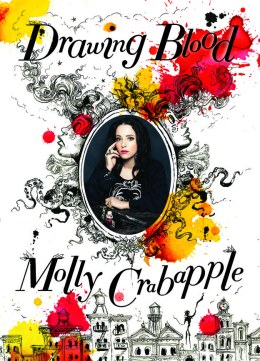
 (Harper), making illustrated journalism from Syria, Guantanamo and Abu Dhabi, translating Nizar Qabbani, growing into her parents’ legacy of art, Marxism and argumentation, finding her soul in the


 . A few segments were recorded by the guests and e-mailed in (which is to say: don’t blame me!). Processing was done in Audacity and Logic Pro.


 (Top Shelf, 2011), was excerpted in the Best American Comics 2013 and named one of “the best comics by women” by DoubleX. She is a member of
 (which the Boston Globe called, “A virtual bible for artists and day jobs”) and
  . Her writing and art have appeared in The Rumpus, Hobart, The Nashville Review & Booth Literary Journal, among other places.
 feeding into a