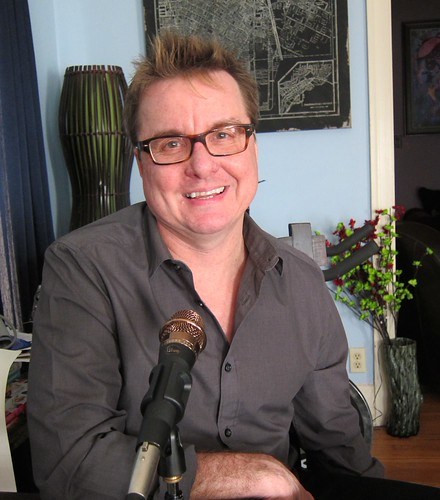
At the end of last year’s writeup, I mentioned that I was 10% of the way into Winter’s Tale . I bailed on it; just wasn’t feeling it, which may have been due to reading it on my Kindle vs. print. I also mentioned that I’d like to read the rest of Sebald’s novels, James Salter’s Light Years
 , Thomas Pynchon’s Bleeding Edge
 , Joseph Roth’s The Radetzky March
 , Dante, Bruce Jay Friedman’s Stern
 , and Daniel Kahneman’s Thinking, Fast and Slow
 . How’d I fare? I didn’t get to Sebald or The Radetzky March, I gave up on Light Years after 100 pages, did read Bleeding Edge, Stern and the whole Divine Comedy, and never got back to Kahneman’s book.

Click on the pic above to embiggen
Reading for my Virtual Memories Show podcast dominated my book selection this year. Around two-thirds of the books I read were by guests or were for background for our interviews. I’m not complaining; a lot of them were really good, and I may never have gotten around to them without the impetus of the show! There were some periods where I was chasing, or just trying to stay afloat with reading. That said, when I finally got ahead of the guest list in April, I took it upon myself to read Dante, which of course turned out to be fantastic.
Anyway, I read more than 50 books this year, but not all of it was Dante-sized. I still haven’t made an appreciable dent in my library, which keeps creeping up as new pod-guest-books come in, along with my own purchases and gifts from pals. I’ve asked our handyman to build me a couple of book carts, so I can pretend that there’s enough shelf space downstairs for everything.
The list below only includes prose work. I feel like including comics would be cheating, but I do have to say that one of the best books I read last year was Roz Chast’s graphic memoir, Can’t We Talk about Something More Pleasant? , about her parents’ deaths in their mid-90s. If you’re using this as a shopping list, definitely put that one at the top. If you read smart comics, you should also check out Here
 , by Richard McGuire, a full-length version of the groundbreaking six-page comic he made in 1989. You’ll never look at a corner of your living room the same again. (Don’t take my word for it; here’s Chris Ware’s take on Here.) And give Over Easy
 , by Mimi Pond, a read. (I did a podcast with Roz Chast, and pair with Mimi Pond. Here’s the one with Roz, and part 1 and part 2 with Mimi.)
Unlike past years, I’m not going to take this space to ruminate on midlife, mortality, the pleasure of books, etc. Well, it’s all about the pleasure of books, I suppose. Enjoy, and good reading in 2015!
Notes: (r) means it’s a re-read, and all the podcast links are directly to mp3 files. You can subscribe to the podcast over at iTunes. And you can always check out every book I’ve read since 1989.
* * *
Strange Relation: A Memoir of Marriage, Dementia, and Poetry – Rachel Hadas – Read it for the podcast, as recommended by past guest Willard Spiegelman. It’s a memoir about the period in which Rachel’s husband developed early-onset Alzheimer’s disease. It’s a beautiful book that details both her husband’s decline and the poetry that helped sustain Rachel through that gradual, terrible loss. I’m a poetry imbecile; that is, I don’t spend enough time with poetry, because of my preference for novels, but I was pretty immersed in this one. Listen to our podcast!
Searching for Zion: The Quest for Home in the African Diaspora – Emily Raboteau – Read it for the podcast, as recommended by past guest Peter Trachtenberg. It’s the author’s exploration of race as she travels the world. She’s a very light-skinned black woman, at least by American standards. In Jamaica, she’s considered white, and in Africa, she’s something else completely. It’s a compelling book about identity and blackness in America. Listen to our podcast!
Comics Art – Paul Gravett – Read it for the podcast, in time for a business trip to England, where I connected with the author. It’s a good overview of the comics form, without the America-centricity that can crop up in that sort of survey. The book was commissioned as part of the Art series for the Tate, and it does have a sort of museum aspect to it, but I mean that in a good way. Paul is so so knowledgeable about comics, and it was a pleasure to read the book and then talk with him for something like four hours over an afternoon. Listen to our podcast!
Black Cracker – Josh Alan Friedman – Read it for the podcast, as part of my “Capturing The Other Friedmans” series of interviews. It’s a fictionalized memoir of Josh’s childhood, where he wound up as the only white student in an all-black school in the ’60s. It’s hysterically funny, but I was a little nervous about people noticing the cover while I was reading it on a British Railways ride. The book was particularly interesting because I read it after reading Josh Alan’s youngest brother’s book about their childhood (Barracuda in the Attic
 ), their dad’s memoir (Lucky Bruce
 , which I reread soon after this), and hearing middle brother Drew’s stories about childhood. It’s not like a Rashomon situation, but each rendition creates a fuller picture of the tensions and dynamics of these kids and their parents. I’d love to get all the family together for a group interview, but I’m afraid it could lead to bloodshed, possibly mine. Listen to our podcast!
Stern
About Harry Towns
The Current Climate
Lucky Bruce: A Literary Memoir (r)
A Mother’s Kisses – Bruce Jay Friedman – Read it all for the podcast, but also because I made the discovery of Bruce Jay Friedman’s fiction in 2013. (As you may or may not recall, I wrote, “I realized that this was the sort of writing I wanted to pattern my own fiction after. . . . I finally found the writer who could tell funny, witty, engaging stories about men (Jews and gentiles) without having to draw a literary-cosmic conclusion about the universe.”) Stern and A Mother’s Kisses supported the claim Bruce’s son made to me, that their dad was Philip Roth before Philip Roth. The two books of Harry Town stories, About Harry Town and The Current Climate, helped me think more about my Abe Loesser stories. Several of the chapters in them mirror episodes from BJF’s memoir, Lucky Bruce, which I re-read once we were definitely on to record a show. I was interested in how Bruce rewrote the stories of his life for fiction and for memoir. We didn’t go into that topic extensively during our conversation, but it did give me a sort of license to play more with my experiences and bend them out of strict re-telling and into art. Listen to our podcast!
The World of Yesterday – Stefan Zweig (tr. Anthea Bell) – Technically not for the podcast, although it did serve as background when I interviewed George Prochnik a little while later. This was the new translation of Stefan Zweig’s memoir, which he sent out to his publisher shortly before his suicide in 1942. It paints a magical picture of pre-WWI Vienna, and a harrowing picture of Austria after that war. Some of the most evocative material is about Zweig’s own development, and what it was like to live in a time when one could travel the world without a passport. The New York city segment is a joy. It’s a remarkable book. I don’t know if there’s a “key” to understanding Zweig’s suicide, but contrasting the world of yesterday with the future that was unfolding — even with an Allied win over the Axis — it was clear that Zweig didn’t want to live through another reconstruction or face a bureaucratized future. Listen to my Zweig podcast with George Prochnik.
Visible City – Tova Mirvis – Read it for the podcast. This was pitched by the publisher, and I had some reticence about it; from the description they gave, it sounds like Mommy Lit, which is not my thing. It had more going on than that, lucky for me, in terms of urban exploration and struggling with Judaism. I was bummed to find that the closing line of my short story about the High Holidays was mirrored in her book, as a minor line describing a character, but I refused to give it up. Listen to our podcast, even though I didn’t do a good job on this one, for a variety of reasons.
The Elephants Teach: Creative Writing Since 1880 – DG Myers – Read it for the podcast. The first non-fiction / non-memoir of this year’s reading. The late Prof. Myers (he died in September 2014) writes a wonderfully readable history of creative writing programs, from their inception to the mutant self-replicating form they’ve evolved into. It’s an illuminating piece of scholarship about a system that seems broken at first glance (that is, treating creative writing as an accredited program leads to teaching it for the sake of making more formulaic writers and/or more creative writing teachers); with an understanding of its history, we see far better how it ended up like this. Note: I’ve never taken a creative writing class. Listen to our podcast!
Hyde – Daniel Levine – Read it for the podcast. It’s not exactly a revisionist take on The Strange Case of Dr. Jekyll & Mr. Hyde, not like that book about Ahab’s wife. Rather, it tells the classic story from Hyde’s perspective. I was suspicious about the premise (it was another book pitched by the publisher), but it’s really well written and Levine does a great job of making sure his story fits into the mechanics of the source story. Giving voice to Hyde — and not going with the easy out of making him the unrestrained id of the Victorian era — Levine manages to create a tense horror story that we thought we knew. Listen to our podcast!
Not pictured: The Bookshop – Penelope Fitzgerald – I picked this up on the suggestion of DG Myers. I’d never read Fitzgerald, and zoomed through this one over the course of an afternoon. It’s gorgeous and understated, and apparently that’s a hallmark of her work. I picked up the two Modern Library collections of her work recently, and plan on reading more of her work. I’m awfully sad that I won’t get new recommendations from Prof. Myers, but he left a wealth of writing about literature on his blog over the years.
The Cold Song – Linn Ullmann – Read it for the podcast. It’s a lot of books: a murder mystery, a fairy tale, a family drama. I was swept up by the fragility of the characters, the compulsion to lie, the unendingness of a family’s grief, the ways in which loved ones fail to communicate. It’s set in Norway, but it almost feels like another world. It’s such a strange and compelling book, while seeming “normal” on its face, that I can’t really come up with the right words to describe it, beyond “You should read this.” Listen to our podcast: part 1 and part 2!
Mortality – Christopher Hitchens – Another suggestion of DG Myers, who was working on a book about his cancer experience. In our conversation, he lamented that Hitchens died so soon after his cancer diagnosis, because he hoped to see more writing from Hitchens about the process of dying. Ironically, Myers himself died far sooner than he expected. He thought he had another one or two years of life when we spoke in March, but he died six months later. And now those of us who knew him can lament that he too died before he could tell us more about Life on Planet Cancer (the title he settled on for his book). Hitchens’ essays come from the incredibly specific experience of his cancer, but his graceful writing brings it to life.
Not pictured: This Is Where We Came In: Intimate Glimpses – Lynne Sharon Schwartz – Read it for the podcast. We met at Bennington in 2013 when I drove up to interview David Gates; they’re both part of the Low Residency MFA faculty. These essays remind me very much of Phillip Lopate’s work, and it makes me wonder if that’s coincidental or if there’s a sort of generational approach to the personal essay that they both characterize. Probably the former. The centerpiece of the book is an essay about her heart surgery, and it’s digressive and detailed and a wonder to read. Listen to our podcast!
All That Is – James Salter – Likely the final book by a great American author I didn’t get around to until 2013. That year, I read A Sport and a Pastime
 and Solo Faces
 , and felt stupid that I’d missed out on a hybrid of Hemingway and Henry Miller all these years. His new book extends to cover the shape of a man’s life, with its myriad mistakes and friendships and failed loves and admission of age. For some reason, I felt echoes with Philip Roth’s Everyman, although Salter’s language is more beautiful than Roth’s.
The Divine Comedy, Vol. 1: Inferno
The Divine Comedy, Vol. 2: Purgatorio
The Divine Comedy, Vol. 3: Paradiso – Dante (tr. Durling) – As I mentioned in the intro, I got ahead of the podcast-reading list around April, so I took the opportunity to read Dante’s Divine Comedy. I picked this translation on the recommendation of one of my tutors at St. John’s College. It’s a prose translation with line breaks that mirror the poem; he and another tutor I consulted with contended that it’s better to go with a prose translation than a rhyming one, because Dante’s Italian is almost impossible not to rhyme, and it forces a false rhythm on the text. Anyway, it deserves all the accolades, and I weirdly found Purgatorio to be more enjoyable than the Inferno. I think it’s because the souls in Purgatory, even while they suffer awful torments, have hope that they’ll complete their purgation and ascend to Paradise, while the souls in Hell have abandoned all hope. Paradiso, I have to say, was the least enjoyable of the three poems, probably due to being the least concrete. Its abstractness and focus on the church’s founders/pioneers didn’t resonate with me the way the suffering and the stories of the lost did.
The Impossible Exile: Stefan Zweig at the End of the World – George Prochnik – Read it for the podcast. One of the best books I read this year. It’s a biography covering Stefan Zweig’s final years, leading up to his suicide in 1942, but it’s also about Prochnik’s father’s flight from Austria. I found it to be a beautiful work, meditating on the meanings of exile, Zweig’s inability to cope with refugee life in New York despite his privileged position, and the culture that was lost with the rise of Nazism. Prochnik travels to many of Zweig’s waypoints during his last years — England, Manhattan, Westchester, Petropolis — but the book’s most haunting moments come in Austria. It’s a fantastic book (and one I would’ve read regardless of the podcast possibilities). Listen to our podcast!
Secrecy – Rupert Thomson – Read it for the podcast. An enjoyable novel set in 17th century Florence. It’s got sex, murder, religious hypocrisy (hence the need for secrecy), art and aesthetics, plague tableaux, and a true-life lead character in wax sculptor Gaetano Zummo. I’d never read Thomson before, and apparently his hallmark is jumping from genre to genre and style to style. I’m thinking I need to check out more of his work, but as you can see from the rest of the list, I was a little busy this year. Listen to our podcast!
Not pictured: Solaris – Stanislaw Lem (re) – I reread this one on a whim, just to recapture that feeling of loneliness, of the mystery of experience and the failings of communication. I lead an exciting life.
Nose Down, Eyes Up – Merrill Markoe – Read it for the podcast. It’s a fun novel about a 40-something layabout in LA (named Gil) who realizes one day that he can understand what dogs are saying and communicate with them. Merrill does a great job portraying the world as perceived by dogs, in terms of how they’d logically understand the behavior of humans. They can’t for the life of ’em figure out why we keep picking up their crap and putting it in bags. Listen to our podcast!
Bleeding Edge – Thomas Pynchon – Like many of his readers, I’d wondered if Pynchon would write about “modern times,” as in post-9/11. The closest he came to his own era was Vineland, published in 1990 and taking place in 1984. This one treats of the months before and after 9/11, and it’s as weird, elliptical, funny, not-quite-sensical as I’ve come to expect from his novels. There were segments where this one seemed to overlap with William Gibson’s post-9/11 novels, and I think that’s partly because of WG’s status as a Pynchon novitiate, but also because the general response to these times by any novelist with a Big Perspective is to get caught up in the wheels within wheels of conspiracy, malignity and neglect by Forces Larger Than Us. I enjoyed the heck out of this one, and it made for an interesting segue from Inherent Vice, which takes place in the late ’60s and sorta has to shoe-horn the internet (and its ramifications) into a world that really had No Idea What Was Coming.
Never Mind
Bad News
Some Hope
Mother’s Milk
At Last – Edward St. Aubyn – This series, the Patrick Melrose novels, was recommended to me by Peter Trachtenberg at the end of 2013. Then there was a big New Yorker profile on the author and the ways in which his abusive childhood is mirrored in Melrose’s stories. I devoured the novels in pretty short order. They’re almost a sort of A Dance to the Music of Time
 , but with a smaller cast of characters and history, and with child-rape at the heart of the whole shebang. I enjoyed the first novel the most, mainly because of the utter vividness of Melrose’s monstrous rapist of a father. The second novel, in which Melrose goes on a drug bender while in New York to claim his father’s ashes, is a close runner-up. A lot of “writing as therapy” can make for bad art, but St. Aubyn does a wonderful job of turning the horrific circumstances of his childhood into a compelling series of novels. They’re necessarily brief; I think too much time in any of these tales would grow tiresome, even if there are characters with whom we’d like to spend more time. I’m sure there are plenty of nuances of British culture and class that I missed, but the acid portraits are still pretty amazing.
The Incentive of the Maggot: Poems
The Great Wave: Poems – Ron Slate – Read them for the podcast. Every year, I tell myself that I need to read more poetry, so I was happy to book a podcast with Ron and let myself slow down to read these two collections of his work. I enjoyed the first one more, and he concurred that it’s a better collection, mainly because the lines are given more room to breathe. Many of the poems are grounded in a sort of working life to which I was able to relate: not the labor of the service biz or the factory, but one of Business, where the seeming romance of travel can wear thin and one looks for minor bits of magic to keep from growing numb. Listen to our podcast!
My Face for the World to See – Alfred Hayes – This was recommended to me by Phillip Lopate as one of the best books he’d read in 2013. It’s a novel about a New York writer in Hollywood who falls into a relationship with a suicidal gal. (As in, he first sees her when she’s trying to kill herself by walking into the Pacific.) It’s in a sorta laconic style, where the events, even as they grow more dramatic, aren’t treated with great intensity, even though the narrator is struggling to cope with the relationship. It made me think I need to go re-read Nathanael West next year.
The Horned Man – James Lasdun – Read it for the podcast (we haven’t recorded yet). The novel’s a psychodrama about a college literature professor who may or may not be framed for several murders. There’s a harassment aspect to the professor’s history that gets really weird because, a bunch of years later, the author was accused by a student of harassment and stealing her novel. He wrote a memoir about it called Give Me Everything You Have: On Being Stalked
 , which I’ll be reading before we get together to record. This novel’s enjoyable in its strangeness; once the unreliability of the narrator is established, it’s a little difficult not to fall into a guessing game of “what really happened,” but Lasdun takes the story away from that easy out and proceeds into a surreal conclusion. Podcast coming in 2015!
The Literary Churchill: Author, Reader, Actor – Jonathan Rose – Read it for the podcast. This is a literary biography of Winston Churchill, and Prof. Rose does a marvelous job of connecting the books and plays WC read and enjoyed with his major life points and policy decisions. I didn’t know all that much about WC’s early career, and this book helps illuminate that period of his life along with the aforementioned literary influences (of course, it’s up to debate as to how influential those literary influences were on WC’s decisions, but Rose makes plausible scenarios for many of them). I was glad to learn that Churchill was among the first science fiction politicians. Listen to our podcast!
Doll Palace – Sara Lippmann – Read it for the podcast. I think we connected because she found the podcast I did with David Gates. This collection of fiction is Sara’s first book, and it’s got some intense and powerful short stories in it. The author told me her work’s been described as “Jewish gothic,” and I think that’s appropriate. There’s a degree of Flannery O’Connor to her stories, even though the setting (and the religion) are quite different. She writes good sentences, creates compelling characters, and puts the reader in some uncomfortable frames of mind. Listen to our podcast!
Last Night – James Salter – I was waiting down at the local library for my wife’s bus from NYC (the bus stop is in the library parking lot), and took this slim collection of stories off the shelf. I devoured one story during the wait, checked the book out and read the rest of it over the next 24 hours. I’m still embarrassed not to have discovered Salter until 2013. The title story, about an assisted suicide, has a Poe-like twist/change of tone, but it’s not all about storytelling trickery.
Where To?: A Hack Memoir – Dmitry Samarov – Read it for the podcast. Really fun collection of essays about the author’s career as a cab-driver. He published a previous book on the subject, but that one focused on the work-week, and this one covers Dmitry’s time from his first shift to his last, from Boston to Chicago. He’s also a painter, and the book includes a number of his drawings made while sitting in the driver’s seat of the cab. (Not while driving.) Listen to our podcast!
The Wife – Meg Wolitzer – A few guests and pals told me I need to read her work, and recommended this one. I was pretty disappointed in it; the big twist was pretty obvious to me about a quarter of the way in, and it made the rest of the read a slog until The Big Reveal. It’s about an author and his wife, on their way to pick up a Nobel-like award for his fiction. She narrates it and tells their story. It’s laden with Important Gender Issues to the detriment of not having believable or interesting characters. A pal asked me what book I read in 2014 disappointed me the most, and I didn’t hesitate to cite this one. That’s what I get for listening to my guests.
The House of Mirth – Edith Wharton – I was really not expecting the degree of antisemitism that cropped up early in this one. I loved The Age of Innocence
 when I read it a few years ago, and figured this would be along similar lines, but focused on the female character’s prospects. In broad terms, I was right, but the characterization of Rosedale and “his race” was pretty vile. I’m no PC warrior or anything, but stereotyping Jews (and this wasn’t focused on class-conscious merchant Jews, which would have been bad enough) is the mark of a second-rate mind (at best). I rallied on, and did enjoy much of the book. In fact, Rosedale’s bluntness turned out to be one of my favorite aspects of it, but I had this nettle pricking at me throughout the book.
Backing Into Forward: A Memoir – Jules Feiffer – Read it for the podcast. I wasn’t sure if Mr. Feiffer would follow through on our podcast-date, but I wanted to be prepared if he suddenly said, “Yeah, let’s do it tomorrow.” His memoir, published in 2010, covers a lot of Feiffer’s dizzying career as a cartoonist, novelist, illustrator and screenwriter. He knows how to tell a story, as he’s proved for decades, and weaves comedic tales about his mother-obsessed childhood, his scams and meltdowns in the U.S. Army, his cross-country pilgrimage for a girl had moved on, and his political evolution. He’s led an immensely rich life, and his writing conveys the importance of the outside world on his art, and vice versa. I went into the book expecting an old man’s reminiscences, and was pleasantly surprised by how charged the prose was, and how laugh-out-loud funny Feiffer is. Listen to our podcast!
I Only Read It for the Cartoons: The New Yorker’s Most Brilliantly Twisted Artists – Richard Gehr – Read it for the podcast. Wildly entertaining profiles of a dozen cartoonists at the New Yorker, as well as two of the cartoon editors. It’s a lot of fun, and it’s a blast to read about these cartoonists’ histories, their influences, their work habits, and how they’ve seen the magazine and the rest of the market change. It’s based on interviews that Gehr did with the cartoonists and editors (and which I used as research for a few of my podcasts this year). Listen to our podcast!
Not pictured: Mr. Wicker – Maria Alexander – Read it for the podcast. This one’s an urban fantasy novel (I think; it may be part of another genre) that reminded me in part of Neil Gaiman’s early Sandman comics. It’s about a blocked writer who commits suicide, only to discover herself in a library of children’s hidden memories, governed by a sensual, scorched guy named Mr. Wicker. She gets restored to life, which sets in motion a plot by Mr. Wicker to get out of his eternal job assignment. It’s not a genre I do much reading in, so I was happy to find the book nicely written, carrying the reader along with a good deal of suspense, and not piling on unnecessary “rules” of the magic world that some writers use after they write themselves into a corner. Listen to our podcast!
The Getaway Car: A Donald Westlake Nonfiction Miscellany – Donald Westlake (ed. Levi Stahl) – Read it for the podcast. Past guest Dmitry Samarov suggested I get in touch with Levi Stahl, the editor of this book, and get him on the show, and I’m awfully glad he did. I’ve probably read a dozen novels by the late Donald Westlake (he wrote under a bunch of pseudonyms), but this was the first exposure I’ve had to his nonfiction. If you have any experience with his crime novels, you won’t be surprised to find that he was a wonderful writer even when he wasn’t crafting Parker or Dortmunder stories. This one’s a no-brainer for anyone who cares about the craft and business of writing, particularly in a genre like crime fiction (which Westlake refers to as “detective fiction”). It’s refreshing to read someone who’s so well-versed in the history of the genre, and so willing to talk about the economics of the business. His essays, reviews, appreciations, and letters are a joy to read. Podcast coming in 2015.
Give + Take – Stona Fitch – Read it for the podcast. Enjoyable crime novel about a piano player who doubles as a thief, and the singer-thief he falls for. Having just finished that book of Westlake’s writing, it was little step down, but Westlake was a master, so that’s no big knock. Fitch carries the story along quite well, and the sections on the working life of the piano-player are awfully engaging. Podcast coming in 2015.
Senseless – Stona Fitch – Read it for the podcast. A trade negotiator gets abducted, and gets brutally tortured by his Occupy-esque abductors. The kicker is, his whole experience is captured on live-streaming cameras, and the abductors are raising funds by having viewers vote on his fate. The torture, dragged out over weeks, is absolutely horrifying, and you really should not read this book if you have a weak stomach. I’m supposed to interview the author about a crime novel he wrote under a pseudonym, but I’m sure we’ll have some words about this one, and how he was able to write it. Podcast coming in 2015.
All Those Vanished Engines – Paul Park – Read it for the podcast. Boy, was this a weird one. It’s a metafictional novel in three parts. First, it’s about an alternate world in which the Confederacy won the Civil War with a Man in the High Castle narrative about a future world won by the Union, only both stories are writing each other. The next two segments get really weird, and I’m still not sure what to make of it. The writing’s gorgeous, but I felt that the metafiction was a little too opaque for me, so I’m going to reread Mr. Park’s four-volume White Tyger series to see if that helps me make more sense of this one. There’s a lot of good stuff in this, but metafiction is so difficult to pull off, and I fear I didn’t have enough of a background to get everything I should have out of this. Podcast coming in 2015.
Blood Will Out: The True Story of a Murder, a Mystery, and a Masquerade – Walter Kirn – Read it for the podcast, I hope. At least, the author has said he’s up for recording with me sometime. This may be the best nonfiction book I read in 2014. It’s about “Clark Rockefeller,” who turned out to be a German national named Christian Gerhartsreiter. I was fascinated by the Rockefeller case when it came out that he was a fraud; I couldn’t imagine how his wife went so many years without figuring out her husband’s false identity. Turns out that the author, Walter Kirn, knew Rockefeller for years, and also never suspected the fraud. As Rockefeller is exposed and then charged with murder, Kirn grows more engrossed in the case, and his (and our) propensity to be fooled, to want to be fooled, by the promise of high society. Kirn does a fantastic job of balancing his reporting on the case with his own anecdotes and analysis, playing up his own weaknesses and trying to explore how a novelist, who’s so immersed in understanding character, can fail to see through such an audacious fraud. There’s a degree to which “Rockefeller”‘s ability to take interlocutors’ words and spin new stories to draw them in put me in mind of Borges’ “Tlon, Uqbar, Orbus Tertius“; something about not only the construction of new worlds, but the way they come to infect and permeate what we think of as reality. I can’t recommend this book enough. Podcast coming in 2015.
Not pictured: A Princess of Roumania – Paul Park – The first in a four-book series about an alternate earth and a changeling princess who was hidden in our world (speaking of “Tlon, Uqbar, Orbus Tertius”). As I mentioned in the previous Paul Park item, I started this series to get a better grasp of Paul’s work, so this is technically For The Podcast. It has some deliberate nods to John Crowley’s Aegypt
 cycle of books, although I hope not the final volume, which I couldn’t fathom. This one does a good job evoking the alternate world, alluding to its strange history and laws, while bringing us up to speed on a 20-year plot to hide the princess who can be the salvation of Roumania against those nasty Germans. There’s a scene in the afterlife that’s absolutely breathtaking. Podcast coming in 2015.
Death Comes for the Archbishop – Willa Cather – The last book I finished in 2014. One of my podcast-guests considers it The Great American Novel, so I was expecting a very different book than the one I got. It’s about a pair of Catholic missionaries in the American southwest after the Mexican-American War, and it’s almost a collection of anecdotes, rather than a novel. I literally had no idea what to expect from the book, but the title left me thinking it’d be a Whiskey Priest tale, with awful, dissolute people abounding. Instead, it’s a very Catholic novel. At least, I’m hoping that’s why I felt so disconnected from it. It’s a beautiful work, with the landscape serving as a lead character, but I did feel as though its outlook was somehow alien to me. At first, I attributed it to the 1850s SW setting, but one of my favorite novels (The Leopard) is set in 1860s Italy, so that wasn’t it. I think the purity of the two missionaries’ vision of the world (not that it was naive), demonstrates a type of grace that I just don’t feel in my life. Also, I was watching season 3 of Breaking Bad at the same time, and that’s a very different vision of New Mexico right there.
* * *
And that’s it for 2014! At the moment, I’m in the second book of Paul Park’s White Tyger series, as I mentioned, along with Sarah Bakewell’s How to Live: Or A Life of Montaigne in One Question and Twenty Attempts at an Answer . I’ve got plenty of podcast-related reading for 2015, but I’m also hoping to get to Climates
 (Andre Maurois), Erasmus’ Praise of Folly
 , more Stefan Zweig, Lucretius’ The Nature of Things
 (a re-read), and The Big Con: The Story of the Confidence Man
 (David Maurer).
Why don’t you go check out the past editions of this writeup?
 Witold Rybczynski joins the show to talk about architecture! The renowned writer, scholar, and former architect discusses his newest book, How Architecture Works: A Humanist’s Toolkit


 (Other Press). We also discuss the confluence and divergence of love and happiness, her surprise when
 (Knopf, 2008). Her newest book is
  . Processing was done in Audacity and Logic Pro. Photo of Ms. Reza by
  Educator (and high school pal)
  . We talk about edutainment’s bad rep, developing good games for students, getting getting buy-in from faculty, administration and — most importantly — students, the subjects that benefit most from game-based learning, and why Pandemic is the best game he’s ever used to teach. I also vent about how primitive the technology was when Matt & I were in school, compared to having 3-D printers in the classroom nowadays. Oh, and we get around to dismissing Roger Ebert’s claim that games are not art!


 .
. in 2004. The 2010 Frank story
  won The Stranger’s Genius Award and was a finalist for the Los Angeles Times Book Prize for that year. Woodring has published two more FRANK books,
  , and
, and  .
. in 2005), and the sculptures, vinyl figures, fabrics and gallery installations that have been made from his designs. His multimedia collaborations with the musician


 This episode features selections from nearly 3 dozen of our recent guests! So