I’m crazy-stressed with work (you’d laugh if you saw the work-calendar I put together for this month), but here’s some Unrequired Reading action for you, dear readers!
Continue reading “Unrequired Reading: June 18, 2010”

A podcast about books, art & life — not necessarily in that order
I’m crazy-stressed with work (you’d laugh if you saw the work-calendar I put together for this month), but here’s some Unrequired Reading action for you, dear readers!
Continue reading “Unrequired Reading: June 18, 2010”
Happy Memorial Day weekend, dear readers! Let’s kick off the long weekend with some Unrequired Reading!
Continue reading “Unrequired Reading: May 28, 2010”
What I’m reading: Fly Fishing with Darth Vader
What I’m listening to: Bob Mould’s The Last Dog and Pony Show


What I’m watching: The Hangover, which was better than I expected it to be. Crank, which was worse that I expected it to be.
What I’m drinking: Aviator & Q-Tonic
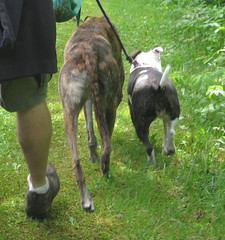 What Rufus & Otis are up to: Going to a party thrown by one of our fellow Sunday greyhound-hikers. There were a dozen or so greys and one black lab in attendance. Sadly, Ru got spooked by some hunters shooting way off in the woods, and spent some time curled up and cowering in various spots, including the bottom of a concrete stairwell off the patio. The other owners were sad that Ru was so skittish about that noise, but I figure it’s better to be nervous about guns than blithe. Otis, on the other hand, just puttered around the yard (2 acres, fenced in) all day, hoping to get food from our plates. On Sunday, they went on their first greyhound hike in a while. Otis was obsessed with a year-old pit bull that one of our group brought along (with her three greys), and was ready to choke himself trying to get to her. Eventually, I asked her owner if I could walk the two of them together, since that might make it easier. From there on, Otis became Daisy’s shadow, trotting alongside her at an even pace, his tongue lolling onto the top of her head. It was pretty funny to watch.
Where I’m going: Nowhere!
What I’m happy about: Getting some grey-social time in this weekend. Also, working at a relatively small (12 magazine) B2B company.
What I’m sad about: Not getting more of that Weakly series of posts written, because the memories are already fading.
What I’m worried about: Getting the June issue together this week. It feels like there’s no break from one ish to the next.
What I’m pondering: All those stories that are lost when we die. Also, that Kabbalistic notion that the world is a broken vessel and that our role is to contribute to its repair.
It’s post-April Fool’s Day Unrequired Reading! The only joke I fell for was the one about how LSU was going to install a purple turf for next season. Now go read some of my carefully curated links!
Continue reading “Unrequired Reading: April 2, 2010”
Apparently, there’s a kerfluffle going on about whether Martin Heidegger’s philosophy should be shelved alongside Nazi history books and Mein Kampf. See, Heidegger was an ardent member of the Nazi party, and the argument is that his philosophy is Naziïsh, too, and Nazis are bad so his books shouldn’t be available without a warning label! Or something.
Tim Black at Spiked! does a great job of exploding that argument in this article, showing how the philosophy has no fascistic trend in it at all, and in fact lends itself more to left-wing, anti-modern thought. In my experience, Heidegger’s pretty difficult to explain in layman’s terms, but Black does an admirable job of portraying both Heidegger’s philosophy and the impact it had on 20th century thinkers.
What is “my experience,” you ask? Well, despite having virtually no background in philosophy, I studied Heidegger’s main book, Being And Time
Given Heidegger’s dense prose (translated from German, the densest language known to man), my aforementioned inexperience, and our professor’s Eritrean accent, I did not have an easy time of things in that class. Still, Tsenay did his best to convey something of Heidegger’s philosophy to a novice like me. (He also told us at the outset that he didn’t want to discuss Heidegger’s role in the Nazi party, especially since Being and Time was published long before Hitler’s rise, and should stand on its own.)
In one of the more concrete (albeit limited) examples, Tsenay addressed Heidegger’s contention that animals do not have emotions. “Here, I disagree with him,” he said. “You see, I believe animals have strong emotions. However, Heidegger is right to say that animals are not people, not da-sein; that is because they do not possess anxiety, the awareness of being-toward-death.
“When I was a Ph.D. student at Boston College, I had a little cat in my apartment. Every morning when I headed out to class, he would follow me out the door and down the street for a while. But every Tuesday, the garbage men would be outside with their bigbig trucks! And my cat would hear them and runbackinside as fast as she could.
“So, you see, when she runs from the garbage men, here the cat is demonstrating fear. But she is not evincing anxiety. If she were, then she would be sitting up every Monday night, worrying about the garbage men!”
For the rest of the session, I envisioned a housecat chewing away on its claws all night. I was not exactly living up to my utmost potentiality for being.
Just kidding: see, utmost potentiality for being is actually Heidegger-code for death! Now you’ve learned something! So go read Tim Black’s article already!
(Bonus Tsenay anecdote! He and I talked about Israel’s airlift of Jews out of Eritrea following the civil war there. I marveled over the concept of taking all the seats out of a 747 and jamming as many people as possible in per flight. He said, “They don’t understand, the Israelis. Eritrea is not Europe. In Africa, we do not have a revolution and then decide to kill all the Jews.” He had a way with words.)
Geez! The year’s almost over! Have some Unrequired Reading, whydon’tcha? Just click “more”!
Continue reading “Unrequired Reading: Dec. 4, 2009”
Off to L.A. this weekend, dear readers! I’ll be busy with an online project for work, so there may be no “What It Is” on Monday. Like you care. Anyway, since you’re just here for another installment of my idiosyncratic links, just click “more”!
Continue reading “Unrequired Reading: Nov. 6, 2009”
Guess who’s about to finish his last regular issue of his magazine for the year? (The year-end one is a big directory.) No sad trombone for me!
Want some links? Just click “more”!
Continue reading “Unrequired Reading: Oct. 30, 2009”
It’s been another wipeout of a week for me, dear readers. But I’ve got one of my 20-year high school reunions coming up this weekend, so I’m trying to enhealthify. Not that you care. You’re just here to see the latest collection of links that I think you sortamaybe should read. So just click “more”!
Continue reading “Unrequired Reading: Oct. 9, 2009”
