Following his quintuple-bypass a few years ago, my old man began compulsively buying watches. He bought a ton of them on ebay, convincing himself they were genuine Breitlings and such . . . for only $50!
Dad even bought cases that auto-rotated the watches, keeping their automatic winders winded. He must’ve bought more than 30 watches in the months following his recovery. He gave me one; it promptly crapped out. At one point he told me, “I don’t understand why I’m so interested in these now.”
My father, 67 and really facing mortality for the first time, could not put together the connection between having surgery for his ticker and the compulsion to buy timepieces. Literary symbolism is not his strong suit.
I try to be more honest with myself. Two weeks ago, I bought a nice watch to celebrate turning 40. It cost a bunch more than I ever thought I would spend on a watch, but that’s not saying much, since I never thought I’d spend more than $25 on one.

I did some other things for my 40th, too.
The day began with a torrent of e-mails and Facebook notices from friends and family wishing me a happy birthday. I was cheered by them. I know it’s easy to send a quick b-day note to someone on Facebook, but still: it’s a few moments that someone took to think of me. I felt a little guilty about the birthday notices I’ve let pass by when I log on in the morning.
What did turning 40 mean to me? I’m not sure. I think I wanted to invest it with some sort of meaning, but I don’t feel as if a rubicon has been crossed. I’m realistic about what I’ve achieved so far, and am perversely looking forward to how fast the world will pass me by.
Once upon a time, I thought about quitting my job at 40 and spending a year writing and reading, but the prospect of re-entering the job market at 41 filled me with dread. So instead I just took the day off.
My birthday fell on a Tuesday, so after I finished editing some articles, I made my way into New York City for a few hours. My plan was to take care of some errands and then go to the Met to spend some time with a Rembrandt or two.
The errands consisted of returning some boots at the Billy Reid store on Bond St., where I came across the latest in Auschwitz fashion —

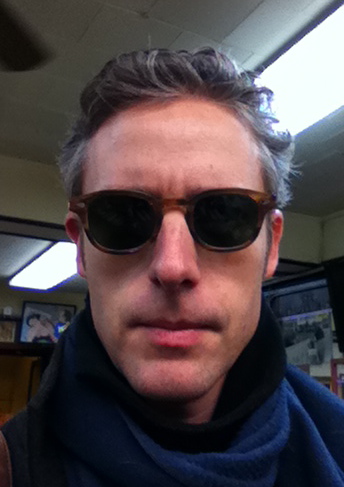
— and Sol Moscot opticians on Rivington St., as recommended by my pal Mark (as well as Anderson Cooper and John Hodgman). I ordered some prescription sunglasses, in the Lemtosh style:
From there, I drove to the Upper East Side. I’d written about the area a few days earlier in that piece about the movie Metropolitan, but I didn’t have much basis of comparison for the UES of today vs. c.1989. I’m sure it’s undergone some degree of New Jersey-fication, as the rest of Manhattan has.
I found an underground garage on 71st that had an entry ramp so steep I literally couldn’t see it beyond the hood of my Outback. There was a moment of panic where I thought it might just be a 50′ drop to oblivion, but was sure there would have been an expose about it in New York Magazine by now.
Safely parked, I walked out to Madison Ave. and decided to make a pilgrimage to the Ralph Lauren men’s store at the Rhinelander mansion on the corner of Madison and 72nd.
For me, retail therapy rarely involves actually buying anything. I’m content to walk through stores, look at wares, and maybe make snide observations about people’s shopping habits. Or, in the case of Ralph Lauren, I marvel over the way the entire retail environment is put together. See, stores really can have a narrative structure to them. It’s rare, at least in menswear (and especially in my suburban setting), to find one with a really well planned arc. Generally, they’re simply assembled in a psychographic/planogrammatical manner intended to maximize large-margin sales.
But a few months ago, I visited the Lauren store in Short Hills Mall in NJ (or, as Amy & I call it, “Rich People’s Mall”) and was struck by how carefully the shop was curated, how the various collections/labels were demarcated, how the tone of the store changed from area to area. And so I wanted to visit the new men’s store at the Rhinelander to see if that retail vision could be writ large.
Please note: I only own one piece of Ralph Lauren clothing. It’s a gray blazer I picked up in an outlet store. It looks awfully good, but it may be the cheap brand they make specifically for outlets. I’m not one to spend thousands on a single article of clothing, even if I have upped my wardrobe game in the past year. (Hint: you can get by with less expensive gear, but be sure to take your things to a good tailor. And no, your local dry cleaner doesn’t count.)
So, even though I was only window-shopping, I was nonetheless blown away by the layout and display of the RL mansion. The floor-by-floor transitions among collections were sharp, but not disconcerting, while the clothes and shoes themselves were presented beautifully. The elegance of the Black and Purple Labels segued with the rustic RRL section and the more affordable Polo collection. The only jarring experience was the RLX collection on the top floor, a brand so distinct that its sharp white walls and neon-colored sports/performance-wear have to be cordoned off from the rest of the joint.
I walked through the sections for a bit, laughing over price tags, listening in on wealthy British and Brazilian tourists as they talked about suits or casualwear. I demurred each request to help by the sales staff, which must have pegged me as a window-shopper. I wasn’t dressed poorly for the occasion, but I surely didn’t give off an air of money.
Once I’d had my fill, I walked up Madison for one more bit of menswear-meandering. JCrew had recently opened a men’s store on 80th & Madison, and some of the style-bloggers I follow (I’m not ashamed) praised it pretty highly. Sadly, compared to the Rhinelander, the JCrew men’s store was like a barn. It wasn’t simply the luxury of the RL goods, but the presentation and general sense of curation that made the JCrew shop pale in comparison. It’s good to know that my snobbishness can transcend literature and comics.
On the walk up Madison, I saw three things:
- an autograph store with a letter by Alexander Hamilton in the window, since we share a birthday,
- Tom Selleck (possibly), and
- the Whitney Museum.
I’d never visited the latter, and had no idea that its facade is a monstrosity:

Some people praise this building to the heavens, but it just looked brutal (not Brutarian, necessarily) to me. There’s an exhibit about Edward Hopper at the museum, so I thought I’d stop in and see it on the walk back.
But first, I needed food & caffeine. I stopped for lunch at an espresso bar called Sant’Ambroeus. The tone of the place reminded me of Milan, although less dirty and much more moneyed. I staked out a small table in the front of the place, ordered a coffee and two little prosciutto and mozzarella sandwiches ($9 each) and broke out my notebook to write about The Day So Far.
There was a steady parade of customers who lived in a different world than mine. Some of the women were Real Housewives-like in their opulence, plastic surgery, and vapidity of conversation. A middle-aged jet-setting British couple chatted at the table to my right, while a Bulgarian-Israeli fashion model to my left kept jabbering on her cell and adjusting her cleavage.
Looking up from my notebook, I found myself being glared at by a pair of European men in their 50s, who gave me the impression they were connected to one of the modern art galleries in the area. They were stylishly dressed, waiting for one of the few front-tables to clear, and fixated on mine. I imagined an art-house version of Road House, where I was challenged to a fight because I’d inadvertently sat at Their Table. Once the Brits left, they moved in.
Waiting for my coffee, I played wih my iPhone for a few moments. The sitemeter for my blog revealed a flood of hits coming in throughout the day. Investigating further, I discovered that my previous day’s post about Metropolitan caught the attention of someone on a forum at Criterion Collections. Between that web-traffic and the ongoing e-mails of birthday wishes, I felt pretty good.
Fed and caffeinated, I headed back out to the street. On a whim, I checked out a gallery called Other Criteria. The main room was a gift shop of various modern art books, DVDs and other paraphernalia. Further back was a room with a number of first editions of books from the 1950s and ’60s, followed by a room with international art magazines. A staircase with stenciled footprints led me down to a well-lit gallery.
The exhibit was of Damien Hirst’s work (he’s one of the co-owners of the gallery/store). Several of his human skulls were on display under glass; only the $25,000 variety, of course, not the $100 million one. There were various wallpapers from his studio on the walls. Rolls were going for $700, I think. I laughed over some of the pharmaceutical-oriented wallpaper. I consider most of this era’s art to be bullshit, but if it’s able to part rich people from their money, then more power to the artists.
Back outside, I decided to pass on visiting the Met. I was feeling a bit anxious, and worried that the sheer volume of people in the museum would drive me further into myself. I’m funny like that. I mean, I’d been alone all day once my wife had left for work, I’d missed phone calls from my mom and my brother — my old man didn’t call till 6:30 or so that night; I’m pretty sure he was tipped off — and had only spoken to garage attendants, the wacky old Italian salesman at Moscot’s and the manager at Billy Reid, but I felt pretty good. I felt like I wasn’t rushing anywhere, like the day was just for my whims as I chose to follow them.
(Just to be clear: this wasn’t anxiety. This was worrying about anxiety. Yes, I’m 40 years old and still experience this.)
I walked down Madison to take in the Hopper exhibition, only to discover that the Whitney was closed for the day. Undaunted, I walked down to the Frick Museum, one of my favorite museums in the city, where I could commune with the Vermeers, Whistlers, Turners, El Grecos, Holbeins, and of course the Rembrandts.
One of my favorites is a self-portrait from 1658. He’s seated, holding a stick, awash in browns, golds and reds. His dark eyes look out from under the shadow of his hat. Oh, heck. you can just look at it here.
When my old man was in the hospital for that bypass surgery — you remember the beginning of this post, right? — he was in intensive care for a while. The morning after the surgery, his girlfriend and I were standing vigil for him, when the doctor told us about the internal bleeding dad had suffered, and how they’d need to keep him sedated for a while, until he was stable. We stayed for an hour or more, while nurses attended to him in various states of what seemed like an emergency. My anxiety grew pretty intense, and I eventually begged off the scene. Dad’s girlfriend said she’d call if there was any change.
I went to the Frick that day, and for the first time I realized that Rembrandt’s self-portrait looked like my father. After his recovery, I bought him a small, framed reproduction of it.
What I’m not saying very clearly is, if 40 means anything to me, maybe it’s as a measuring stick of where I am in relation to Dad. I don’t want to go into that too much right now; I’ve been thinking a lot lately about our relationship, and I’ll write more about that when the time’s right. But I thought it was only fitting to spend some time with that Rembrandt self-portrait on this special day.
So you can imagine my disappointment when I learned it wasn’t on display. (I think it’s being cleaned up or otherwise prepped for the Frick’s coming Rembrandt exhibition.) I took a deep breath, turned around in the West Gallery, and bathed in the radiance of Turner’s Harbor of Dieppe.
I let the light wash over me for a while, before I took out my iPhone and looked up the painting. “Well,” I thought, “Turner was 51 when he painted this, I’ve still got time to –”
— to what? Not to paint, maybe, but to bring a little more beauty into the world. I thought about the Hirst skulls I’d seen an hour earlier and the Laurana bust that captivated me in previous visits (also not on display this time around). I thought about the sheer gray facade of the Whitney and the light from Vermeer’s windows. Goya’s smiths, forging and forged out of myth, a few blocks from menswear mansions and Eurotrash cafes. I thought about St. Jerome, the first El Greco I ever saw, sending me tripping back to George Orwell’s essay about Henry Miller:
In passing [Miller] refers to an essay that Aldous Huxley wrote some years ago about El Greco’s picture, The Dream of Philip the Second. Huxley remarks that the people in El Greco’s pictures always look as though they were in the bellies of whales, and professes to find something peculiarly horrible in the idea of being in a ‘visceral prison’. Miller retorts that, on the contrary, there are many worse things than being swallowed by whales, and the passage makes it dear that he himself finds the idea rather attractive.
I thought about half my life gone, or fulfilled.
Flooded with myself, I left the Frick and began walking back toward my garage. On the way, I saw the storefront for the Tom Ford men’s store. If I was following whims, why not? I entered the boutique and nodded to the pretty receptionist. Two young salesmen were in the casualwear section, so I walked instead to the formalwear room, eyeballing the $4,000 jackets and their broad lapels. In a side window, the world’s greatest smoking jacket was on display:

I admit that I find Ford an interesting character. I read an interview with him in Fantastic Man a year or two ago, and was struck by his degree of self-invention. I suppose I admire that trait, that willingness to blow oneself up and rearrange the fragments with pieces from the outside world.
But the clothes: impossibly gorgeous, occasionally outrageous, and so far beyond my budget that it was ridiculous. As I walked through the casualwear, one of the salesmen asked if I needed any help. I said, “. . . I turned 40 today and I’m having an aspirational day. I’d just like to look around, if that’s alright.”
“Congratulations, sir! Feel free,” he said. The store was empty but for us. I took it all in for a while: the perfumes, the shoes, the glasses, the . . . ibex horn with a cigar-cutter attached? “It’s for the man who has everything,” one of the men told me when I inquired.
I like to think I have everything, but that’s in the Whitmanian sense of containing multitudes, not ibex-horn cigar-cutters.
Outside, I inadvertently overshot my garage, but found a pair of bookstores on the next corner (Lexington and 71st). I hadn’t been to a bookstore all day. Once upon a time, they would’ve been the center of any trip I made. Now I have 1,500 books at home, a Kindle, and a desire to make up for lost time; I need to browse for more?
I browsed for more. I visited Archivia first, an art-book shop on Lexington. I decided that the only book I would buy there would be the glorious slipcased two-volume illustrated edition of Homer that Chester River Press put out last year. It goes for about $400, so I’m glad I found no sign of it.
A little bit south of Archivia was Bookberries, a thoroughly generic bookstore with a full collection of whatever the latest and best books are. It was a sad last stop for my day-trip, but the last stop always is. I looked over shelves of disposable contemporary books that I’ll never get around to reading, that help to discourage me from my own writing, that add to the cacophany I’m doing my best to avoid. (Present tempest in a teacup excepted.)
And then it was time to go home. I got the car, sat in FDR Drive traffic from the 70s to the Triboro and left voice-mails for my mom and my brother. I thought about how I used to drive up the FDR on Sunday nights after dropping Amy off at her apartment in Stuy Town. The night in 2005 I proposed to her, I sat in some FDR traffic on the way home. I remember calling friends to tell them the news. I remembered my friend Ian’s exclamation of “Outstanding!” I remember my friend Cecily being a sentence-and-a-half into a story before she realized what I had just told her, then bellowing, “WHAT?! Oh, my God! Congratulations!”
The traffic was crawling along, but I smiled. I was 40 years old and I’d had a wonderful day off from work.
 and
and  , to give as gifts, but I did find a book that caught my eye, called
  ).
). . I decided to be nice to Borders and pick it up. I mean, they are hemorrhaging money, but maybe I could help them out a little. But then I decided to check the Amazon price for the book with my phone. I thought, “It’s a $20 book: if it’s $14 or higher on Amazon, I’ll just buy it here.”
 , for a mere $3 in hardcover. Of course, I checked my Amazon app, but found they were selling that edition for $10, and the Kindle version for $14.99 (!). I thought, “Well, I’ll pick this up and maybe read a chapter over my lunch.”
 , a book detailing Judaism’s mystic tradition. I re-learned that Kadmon — to be precise, Adam Kadmon — means “primordial man,†or “original manâ€; it’s not just the first person created by God in the book of
  , but the primal being, the first emanation of the divine before the universe shatters and becomes the world we know. (As per their interpretation of the Torah and its commentaries. I’m a scholar, not an adherent.)
 , and you read what tragedy is — and you look at yourself and think, ‘[. . .], man, this is tragic.’