Episode 155 – Christopher Kloeble

A podcast about books, art & life — not necessarily in that order
Virtual Memories Show #150: Molly Crabapple
Podcast: Play in new window | Download
Subscribe: Spotify | TuneIn | RSS | More
“I always like smart, rebellious young people who feel like the world has done them bad.”
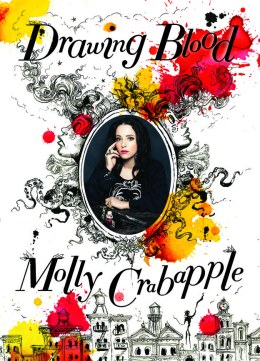 Artist Molly Crabapple joins the show to talk about writing her new memoir, Drawing Blood
“The world hates refugees. I’m convinced that if there was a major crisis in Canada and we had 10 million white refugees, we’d still think of some reason to keep them out. People hate impoverished people fleeing over borders.”
 We also talk about Charlie Hebdo, the Occupy movement, Molly’s success at bypassing the gallery model and whether her path is replicable, the scariest place she’s ever visited as a journalist, her biggest artistic, literary and journalistic influences, and more! (And if you want to find out who she’s reading nowadays, join our Patreon and become a monthly contributor to The Virtual Memories Show!)
Podcast: Play in new window | Download
Subscribe: Spotify | TuneIn | RSS | More
Enjoy the conversation! Then check out the archives for more great episodes! You might like:
Follow The Virtual Memories Show on iTunes, Twitter, Facebook, Tumblr, and RSS!
About our Guest
Molly Crabapple is an artist and writer in New York. She is a contributing editor for VICE, and has written for The New York Times, Paris Review, and the Guardian, among other publications. Her work is in the permanent collection of the Museum of Modern Art. Follow her on Twitter and Tumblr.
Credits: This episode’s music is Nothing’s Gonna Bring Me Down by David Baerwald, used with permission of the artist. The conversation was recorded at Ms. Crabapple’s studio on a pair of Blue enCORE 200 microphones


 Virtual Memories Show #141:
Francoise Mouly
Podcast: Play in new window | Download
Subscribe: Spotify | TuneIn | RSS | More
“I’d rather do something that nobody else would do if I didn’t do it. That’s why I made TOON Books.”
 Live from CXC! Designer, editor and publisher Francoise Mouly joins the show to talk about 20+ years of New Yorker covers, launching TOON Books and cultivating a love for print, the pros and cons of going viral, the changing definitions of what’s offensive (and the time she got hauled into a meeting with an Arab Anti-Defamation League), the notion that comics are the gateway drug for reading, and more! (Sorry, no talk about her time with RAW magazine, since she and her husband, Art Spiegelman were interviewed about that later at the festival.) This episode is part of our Cartoon Crossroads Columbus series of live podcasts. Give it a listen!
“The cover of The New Yorker is where the artists have a voice, on a par with the prose authors.”
 We also talk about Charlie Hebdo, the historical arc of gay marriage covers, the contrasts of her multimodal education in France with the American model, which comics she started her kids off with, how she deals with the moving target of diversity, the evolution of women in the comics scene, and why kids are a fantastic audience. Go listen!
“There are some topics the media won’t touch with the same willingness. . . . It would be more interesting if there wasn’t such jitteriness.”
Podcast: Play in new window | Download
Subscribe: Spotify | TuneIn | RSS | More
Enjoy the conversation! Then check out the archives for more great episodes! You might like:
Follow The Virtual Memories Show on iTunes, Twitter, Facebook, Tumblr, and RSS!
About our Guest
Françoise Mouly is the publisher and Editorial Director of TOON Books, which she launched in 2008. She joined The New Yorker as art editor in 1993. Ms. Mouly has been responsible for more than 1000 covers during her tenure at The New Yorker. The American Society of Magazine Editors (ASME) has chosen many of Ms. Mouly’s images as “best cover of the year.” In 2012, for the publication of “Les Dessous du New Yorker” by Editions de La Martinière, Galerie Martel in Paris presented “New Yorker Covers,” an exhibit of artwork by Mouly and seventeen other artists. Starting in 1980, Ms. Mouly was the founder, publisher, designer and co-editor with her collaborator and husband, cartoonist Art Spiegelman, of the pioneering comics anthology RAW, where Spiegelman’s MAUS was first published. In 1998, after looking for material to help her two children become readers, Ms. Mouly established a RAW Junior division, to publish first the Little Lit

Born in Paris, Françoise moved to New York in 1974. She was named Chevalier in the Order of Arts and Letters by the French Ministry of Culture and Communication. Among the many honors she has received are an honorary Doctorate from Pratt Institute, Gold and Silver medals as well as the Richard Gangel Art Director Award from the Society of Illustrators, and France’s highest honor, the Legion of Honour. She and her husband live in Manhattan.
You can follow Francoise on Twitter at @francoisemouly and TOON Books at @TOONbooks.
Credits: This episode’s music is Nothing’s Gonna Bring Me Down by David Baerwald, used with permission of the artist. The conversation was recorded at the Cultural Arts Center in Columbus, OH during Cartoon Crossroads Columbus in October 2015 on a pair of Blue enCORE 200 microphones

Virtual Memories Show #139:
Derf Backderf
Podcast: Play in new window | Download
Subscribe: Spotify | TuneIn | RSS | More
“My art has become good enough to tell the stories I want to tell. I’m a broken down punk rock geezer, but I’m still a relatively young cartoonist. I’ve only been doing long-form comics since 2010.”
 Live from CXC! Derf Backderf made a mid-career course correction, going from alt-weekly cartoons to full-length graphic novels like My Friend Dahmer

“The most surprising and one of the most personally satisfying thing to me has been the success I’ve had in Europe, especially France. . . . I walked around Paris last week just laughing; I can’t believe my luck.”
 We also talk about the glory days of alt-weekly comics, the mental gymnastics necessary to write Jeffrey Dahmer as a human being, Derf’s observations and adventures in the French comics market, why he decided not to do a book about his cancer experience, how he made more cartoonist-friends after Joyce Brabner kicked him in the ass about being a recluse, and why it’s so much fun to develop good characters who can drive a story. Go listen!
“I did an interview with a big national newspaper in France . . . and the opening question was, ‘We know the rust belt for three things: LeBron James, the Rock & Roll Hall of Fame, and you.'”
Podcast: Play in new window | Download
Subscribe: Spotify | TuneIn | RSS | More
Enjoy the conversation! Then check out the archives for more great episodes! You might like:
Follow The Virtual Memories Show on iTunes, Twitter, Facebook, Tumblr, and RSS!
About our Guest
Derf Backderf was born and raised in a small town in Ohio, outside of Akron. He began his comix career as a political cartoonist, first at The Ohio State University, then at a dying daily paper in South Florida. He was fired for, as the editor put it, “general tastelessness.” Derf then gravitated to the free weekly press where his cranky, freeform comic strip, The City, appeared in over 140 papers during its 24-year run. As weekly papers began to wither, Derf moved to graphic novels, starting with Punk Rock and Trailer Parks
Credits: This episode’s music is Nothing’s Gonna Bring Me Down by David Baerwald, used with permission of the artist. The conversation was recorded at the Cultural Arts Center in Columbus, OH during Cartoon Crossroads Columbus in October 2015 on a pair of Blue enCORE 200 microphones


Virtual Memories Show #123:
Langdon Hammer – The Hidden Wish of Words
Podcast: Play in new window | Download
Subscribe: Spotify | TuneIn | RSS | More
“What I really cared about most, what drew me, was the relationship between lives and work, between how we live and what we do, and what we do with it. And that’s one of James Merrill’s major subjects.”
 Langdon Hammer, Chair of the Yale English department, joins the show to talk about his new biography, James Merrill: Life and Art
“Alchemy is a theme in Merrill’s writing. How is he going to make his own gold, how is he going to transform the lead of his father’s money into a higher value?”

We also learn about Langdon’s decades at Yale and how students have changed during his time there, what the globalization of English poetry means for the form, why he considers The Book of Ephraim to be James Merrill’s greatest poem, and the farthest he traveled to research the book.
Podcast: Play in new window | Download
Subscribe: Spotify | TuneIn | RSS | More
Enjoy the conversation! Then check out the archives for more great episodes! You might like:
Follow The Virtual Memories Show on iTunes, Twitter, Facebook, Tumblr, and RSS!
About our Guest
Langdon Hammer is chair of the English Department at Yale and the poetry editor of The American Scholar. His books include Hart Crane and Allen Tate: Janus-Faced Modernism


Credits: This episode’s music is Lust for Life by Iggy Pop. The conversation was recorded at Prof. Hammer’s office at Yale on a pair of Blue enCORE 200 microphones
Virtual Memories Show:
Christie Watson – The Limits of Love
Podcast: Play in new window | Download
Subscribe: Spotify | TuneIn | RSS | More
“I wanted to explore the idea in this novel that despite love, some families simply cannot survive.”
 British author Christie Watson joins the show to talk about her new novel Where Women Are Kings
“When you write a book, it’s going to be sitting next to Salman Rushdie’s book on the shelf, so by the time you publish, you have to be at the top of your game.”
Podcast: Play in new window | Download
Subscribe: Spotify | TuneIn | RSS | More
Enjoy the conversation! Then check out the archives for more great episodes! You might like:
Follow The Virtual Memories Show on iTunes, Twitter, Facebook, Tumblr, and RSS!
About our Guest
Christie Watson is a British novelist. Her novels, Tiny Sunbirds, Far Away
Credits: This episode’s music is Will My Mother Know Me There? by The Carter Family. The conversation was recorded at the Other Press offices on a pair of Blue enCORE 200 microphones

Virtual Memories Show:
Jonah Kinigstein – Vernissage
Podcast: Play in new window | Download
Subscribe: Spotify | TuneIn | RSS | More
“Everybody was looking for the next van Gogh . . . so that opened up the space for anybody who put two sticks together to be a sculptor, or two dabs of paint on a canvas to be a painter: ‘Don’t miss him! This man is a genius!’ You’re not going to catch the next van Gogh by just throwing everything on a wall.”
 Jonah Kinigstein is having a moment . . . at 92! The painter and cartoonist has published his first collection, The Emperor’s New Clothes: The Tower of Babel in the “Art” World (FU Press) and had an exhibition of his work at the Society of Illustrators in the past few months, and he’s just getting warmed up! We met at his studio to talk about the abysmal and unredeemable state of modern art, and why he elected to stay in the representative mode of painting despite the allure and rewards of conceptual art. He also talks about a near-century of New York City, his glory years in Paris and Rome, his disenchantment with the National Academy, and more! Give it a listen!
“Here I was, studying anatomy . . . and there’s a man who’s dripping on the floor! I’ve got a lot of drippings on the floor; I think I’ll put them up!”
Jonah’s got plenty of venom to spare for artists like Pollock, de Kooning, and Hirst, but also talks about his great artistic influences, his reasons for pasting angry anti-modern-art cartoons on the walls in SoHo, why he paints on wood instead of canvas, and making a living designing department store windows and point-of-sale whiskey displays. It’s a fascinating life, and I’m glad we had the chance to talk! You can check out my photos from Jonah’s studio, including several of his panels, over here.
Podcast: Play in new window | Download
Subscribe: Spotify | TuneIn | RSS | More

Enjoy the conversation! Then check out the archives for more great episodes! You might like:
Follow The Virtual Memories Show on iTunes, Twitter, Facebook, Tumblr, and RSS!
About our Guest
Born in 1923 in Coney Island, Jonah’s early influences were discovered during visits to the Metropolitan Museum- “When I really saw the old masters, it blew my mind, of course.” He attended Cooper Union for a year before he was drafted into the Army, serving from 1942 – 1945. Soon after, Jonah moved to Paris where he spent time at the Académie de la Grande Chaumière, conversing with other aspiring artists, exchanging ideas, exhibiting his work, seeing established artists, and generally soaking up a fertile creative environment. He exhibited in several shows including the Salon D’Automne, Salon de Mai, and the Salon des Moins de Trente Ans, and had one-man shows in the Galerie Breteau and Les Impressions D’Art. After Paris, Jonah moved to Rome on a Fulbright Scholarship and studied at the La Schola Di Belles Artes. After a year, he returned to the U.S. and exhibited his paintings at the Downtown Gallery in Manhattan. Like so many painters, he was unable to make a living solely from painting, so he worked in the commercial art world and did freelance illustration and design. Throughout this time, Jonah’s commitment to his own art never wavered, and he continued to paint and occasionally exhibit.

Credits: This episode’s music is Sous Le Ciel De Paris by Edith Piaf. The conversation was recorded at Mr. Kinigstein’s home on a pair of Blue enCORE 200 microphones