Episode 137 – Scott McCloud

Virtual Memories Show #137:
Scott McCloud – Tumblings

“I want to be working, making comics, and knowing that the thing I’m doing right now is the thing I should be doing and I shouldn’t feel guilty about doing it. I’ve been able to keep that going much of the time for the last 20 years, and it’s kinda great.”

Is Scott McCloud comics’ leading theorist or a deranged lunatic? Find out in this lengthy conversation we recorded during SPX 2015! Scott talks about applying (and forgetting) the lessons of Understanding Comics in his new book, The Sculptor (First Second), the massive implications of crowdfunding for cartoonists and other creators, the problems with ‘balance’ in comics pages, his rebellion against Facebook, the Laurie Anderson model of comics, how he defines success, how to keep a happy marriage inside the comics world, and more! Give it a listen!

“We’ve never seen the consumer dollar at full strength. In traditional print markets, somebody spends a dollar on my work, and I get 10 cents at the end of that chain, that massive army of middlemen. Now we’re seeing what kind of world happens when the consumer dollar stays closer to a dollar. That army of consumers really has an enormous power to put your boat afloat.”

We also talk about his next book (on visual communication and education), his strengths and weaknesses as a cartoonist, making a 500-page comic book that readers could tackle in one sitting, why Reinventing Comics was like “trying to eat 10 lbs. of potato salad”, how every success story in cartooning is unique, the differences in working in print vs. working for the screen, and trying to be a scholar for the first time. Now go listen!

“Craig Thompson’s Blankets is probably off the hook now, because I finally did a comic even more sentimental. So now I made Craig look like Gary Panter.”

We mention a few books in this episode. Here they are:

Enjoy the conversation! Then check out the archives for more great episodes! You might like:

Follow The Virtual Memories Show on iTunes, Twitter, Facebook, Tumblr, and RSS!

About our Guest

Scott McCloud is the award-winning author of Understanding Comics, Making Comics, Zot!, The Sculptor, and many other fiction and non-fiction comics spanning 30 years. An internationally-recognized authority on comics and visual communication, technology, and the power of storytelling, McCloud has lectured at Google, Pixar, Sony, and the Smithsonian Institution. There’s a more extensive and funny bio at his site.

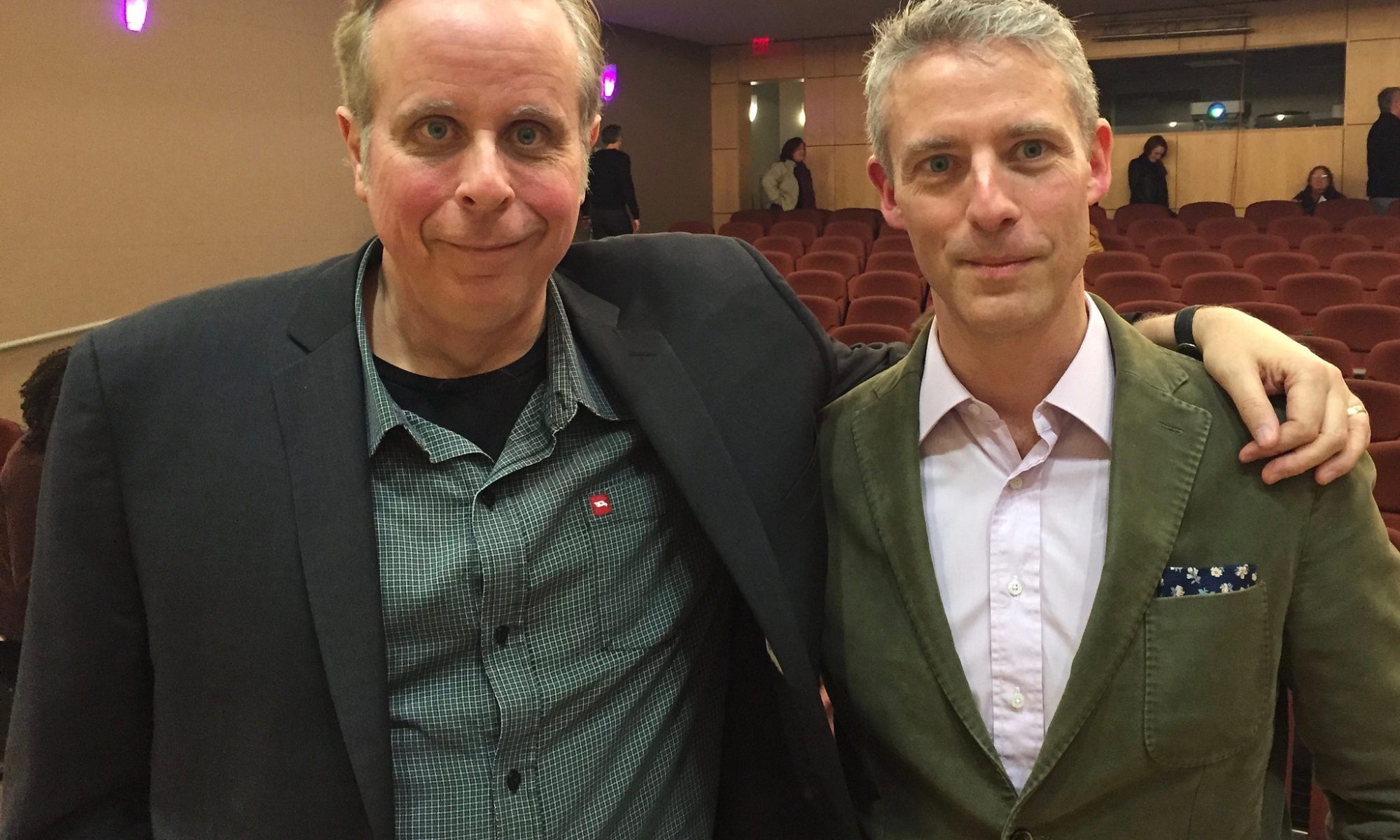
Credits: This episode’s music is Nothing’s Gonna Bring Me Down by David Baerwald, used with permission of the artist. The conversation was recorded during the Small Press Expo at the Bethesda North Marriott Hotel on a Zoom H2n Handy Recorder and a pair of Blue enCORE 200 microphones feeding into a Zoom H5 digital recorder. I recorded the intro and outro on a Blue Yeti USB Microphone. Processing was done in Audacity and Logic Pro. Photo of Mr. McCloud by me.

Episode 133 – What If We Give It Away?

Virtual Memories Show #133:
Stona Fitch/Rory Flynn – What If We Give It Away?

“One of my favorite things is to take a character, figure out what’s most important to them, and then take it away and see what they do.”

ThirdRail_cover_277x419Stona Fitch joins the show to talk about balancing his careers as a novelist, a publisher, and a freelance writer with family life. We discuss his new novel, the crime thriller Third Rail, why he he wrote it under the nom de plume Rory Flynn, his influences and favorite crime writers, the challenges of writing a sequel, the futility of debating genre categories, and more! Give it a listen!

“My mentor Russell Banks told me, ‘Go to Miami, you’ll see everything.’ He also said I’d be a great plumber.”

We also talk about what possessed him to write Senseless, which is one of the most disturbing novels ever written. But don’t worry; it’s not all crime and horror! There’s also Stona’s role as the founder of the Concord Free Press, an innovative, generosity-based publishing house! Plus, we explore the benefits of doing corporate work by day and learning about fields you’d otherwise never have any experience in.

“My wife said, ‘Stona, I think you’ve found a brand-new way for writers not to make money.'”

19399638008_2101009dee_z

We talk about a bunch of books in this episode. Here’s a list of ’em (Note: if I ever go to a Patreon crowdfunding model for the show, this is the first thing that goes subscriber-only):

Enjoy the conversation! Then check out the archives for more great episodes! You might like:

Follow The Virtual Memories Show on iTunes, Twitter, Facebook, Tumblr, and RSS!

About our Guest

Via Stona’s site:

NOW
Praised by critics and readers, Stona Fitch’s novels are published widely throughout the world and have inspired other works, from graphic novels to films. His latest novel, Third Rail (2014, Houghton Mifflin Harcourt), marks the debut of the Eddy Harness series of Boston-based crime novels – published under the pen name Rory Flynn.

Give + Take (2011) crosses genres with a noir-inflected, hilarious road tale. Printer’s Devil (2009) updates A Clockwork Orange to create a post-apocalyptic parable. Critics cite Senseless (2001) as a prescient novel that anticipated violent anti-globalization protests, online hostages, and use of fear as a political tool. It is often described as one of the most disturbing novels ever written. Senseless is now an independent feature film, a graphic novel, and a cult classic.

In 2008, Stona founded the Concord Free Press, a revolutionary publishing house that publishes and distributes original novels throughout the world, asking only that readers make a voluntary donation to a charity or person in need. The first nine CFP books have inspired nearly $500,000 in generosity.

Stona lives with his family in Concord, MA, where he is also a committed community activist. He and his family work with Gaining Ground, a non-profit farm.

THEN
Born in Cincinnati, Ohio in 1961, Stona Fitch grew up in the midwest and south. While an undergraduate at Princeton, he received the Creative Writing Program’s Lannan Award for Fiction. He also served as chairman of The Daily Princetonian, and wrote for The Anchorage Daily News.

After graduation, Stona reported briefly for The Miami Herald before moving to Boston and joining its burgeoning underground music scene. In 1984, he joined the seminal Boston-based pop group Scruffy The Cat, playing electric banjo, mandolin, accordion, and organ–as well as writing songs. He recorded two albums–High-Octane Revival (a New York Times top release of 1986) and the highly regarded (and rare) Tiny Days–before leaving the band in 1987. During this time, he worked as a dishwasher and cook at the Hoodoo Barbeque, a notorious punk-rock hangout/crime scene in Kenmore Square.

Credits: This episode’s music is Nothing’s Gonna Bring Me Down by David Baerwald, which seems to have become our unofficial theme song. The conversation was recorded in the Boston Marriott Burlington on a pair of Blue enCORE 200 microphones feeding into a Zoom H5 digital recorder. I recorded the intro and outro on a Blue Yeti USB Microphone. Processing was done in Audacity and Logic Pro. Photo of Mr. Fitch by me.
Episode 132 – Rootless People

Virtual Memories Show #132:
Christopher Bollen – Rootless People

“I wanted to be a writer since I knew that I couldn’t be a detective.”

tumblr_noaa2szheD1u3hieto1_500We close out the summer of 2015 with a great summer novel, Orient (Harper) by Christopher Bollen! We talk about his new book, the difference between a “smart murder mystery” and a “literary thriller,” the perils of Male First Novel Syndrome (as evinced in Lightning People: A Novel), the challenges of writing about Long Island, how his years at Interview magazine honed his ear for dialogue, his fascination with rootlessness, why it’s too easy to parody the contemporary art scene, and more! Give it a listen!

“Remember how you could totally judge a stranger by what they were reading? Now we’ve totally lost that cue, thanks to e-books.”

We also talk about Christopher’s impending 40th birthday, his reverse mid-life crisis, “kids today,” the people he now realizes he should’ve been nervous about interviewing when he was young, the allure of detective stories, why childhood bookish shut-ins have great skin when they get older, how I once nearly blew up a shopping mall back in my high school years, and whether the actual inhabitants of Orient were peeved about his new novel.

“You don’t interview Fran Lebowitz; it’s more like you’re her audience.”

20344556406_4525650598_z

We talk about some books and movies in this episode. Here’s a list of ’em (Note: if I ever go to a Patreon crowdfunding model for the show, this is the first thing that goes subscriber-only):

Enjoy the conversation! Then check out the archives for more great episodes! You might like:

Follow The Virtual Memories Show on iTunes, Twitter, Facebook, Tumblr, and RSS!

About our Guest

Christopher BollenPortrait_Christopher-Bollen2 is a writer who lives in New York City. He regularly writes about art, literature, and culture. His first novel, Lightning People, was published in 2011. His second novel, Orient, was published by Harper in May 2015. He is currently the Editor at Large at Interview Magazine.

Credits: This episode’s music is Nothing’s Gonna Bring Me Down by David Baerwald, which seems to have become our unofficial theme song (I’ll ask DB if it’s okay to make it official). The conversation was recorded at Mr. Bollen’s apartment on a pair of Blue enCORE 200 microphones feeding into a Zoom H5 digital recorder. I recorded the intro and outro on a Blue Yeti USB Microphone. Processing was done in Audacity and Logic Pro. Bio photo of Mr. Bollen by Danko Steiner; not-as-good photo by me.

Episode 128 – Impecunious Nobles

Virtual Memories Show #128:
Rhonda K. Garelick – Impecunious Nobles

“Chanel was trying to gift herself to women, and give them something that would lend them an allure that would be useful.”

mademoiselle335Rhonda K. Garelick, author of Mademoiselle: Coco Chanel and the Pulse of History, joins the show to talk about Chanel’s impact on women’s fashion and French national identity, how she managed not to get tried for collaboration after the war, the one figure from our age who compares to Chanel, what it’s like teaching the accordion-and-beret crowd, and more! Give it a listen!

“I remain certain that there is no one else who has had this sort of aesthetic influence.”

We also talk about Chanel’s pleasure in hiring fallen royalty to work in her boutiques and factories, the need for myth-making in fashion, the challenges of getting Chanel’s associates to talk to her, the psychological similarities of fashion and fascism, and the decision to structure Mademoiselle around Chanel’s relationships. Also, I make the major mistake of letting Rhonda ask me a question, which sends the conversation utterly off the rails.

We talk about a couple of books in this episode. Here’s a list of ’em (Note: if I ever go to a Patreon crowdfunding model for the show, this is the first thing that goes subscriber-only):

Enjoy the conversation! Then check out the archives for more great episodes! You might like:

Follow The Virtual Memories Show on iTunes, Twitter, Facebook, Tumblr, and RSS!

About our Guest

rhonda250Rhonda K. Garelick writes on fashion, design, performance, art, literature and cultural politics. Her books include Rising Star: Dandyism, Gender, and Performance in the Fin de Siècle (Princeton University Press, winner of the Kayden Award for outstanding manuscript in the humanities), Electric Salome: Loie Fuller’s Performance of Modernism (Princeton), and, as co-editor, Fabulous Harlequin: ORLAN and the Patchwork Self (University of Nebraska Press, winner of the 2011 award for book design from the American Alliance of Museums). Her new book is Mademoiselle: Coco Chanel and the Pulse of History. Her work has also appeared in The New York Times, New York Newsday, International Herald Tribune, and The Sydney Morning Herald, and numerous journals and museum catalogs in the United States and Europe.

She is a Guggenheim fellow and has also received awards from the NEA, the NEH, the Getty Research Institute, the Dedalus Foundation, the American Association of University Women, the Whiting Foundation, and the American Council of Learned Societies. Prof. Garelick received her B.A. and Ph.D. in comparative literature and French from Yale University. She splits her time between Lincoln, Nebraska and her hometown of New York City.

At the University of Nebraska-Lincoln, she is Professor of Fine and Performing Arts and English, as well as the founder and director of the Interdisciplinary Arts Symposium. For the academic year 2015-2016, Rhonda will be the Stanley Kelly, Jr. Visiting Professor of Distinguished Teaching in Comparative Literature at Princeton University. Garelick has also had a long career as an international business consultant, specializing in the fields of fashion, media, and journalism.

Credits: This episode’s music is Cri de Coeur by Edith Piaf. The conversation was recorded at an undisclosed location on a pair of Blue enCORE 200 microphones feeding into a Zoom H5 digital recorder. I recorded the intro and outro on a Blue Yeti USB Microphone. Processing was done in Audacity and Logic Pro. Photo of Prof. Garelick by Agaton Strom.

Episode 125 – Signal Boost

Virtual Memories Show #125:
Dan Perkins (Tom Tomorrow) – Signal Boost

“This Kickstarter, this is me, having seen my incredibly negative narrative and hopeless sense of the future just blasted out of the water. I feel like this week has changed my life.”

25yearsbluesmall-630Dan Perkins (better known as Tom Tomorrow) is celebrating 25 years of his weekly political cartoon, This Modern World, with a kick-ass Kickstarter project to collect all of his strips in a two-volume, slipcased edition! Shockingly (to him, but not the rest of us), his fans hit his funding target in less than 24 hours, and more than doubled it by press time. (It’s open through August 4, 2015, so there’s time to make a contribution!) I caught up with a flabbergasted Perkins to talk about the resounding level of fan support for the project, the detective/archeologist work of compiling 25 years’ worth of his strips, the trepidation he had about looking at his early work, how This Modern World changed after the advent of the internet, the ways in which his cartoons work as a coded diary of his life, how the validation of this Kickstarter experience has changed his view of the future, and more! Give it a listen! (If you want to skip my rambling intro, you should jump to the 8:45 mark.)

“Charles Schulz said if he were a better writer, he’d be a novelist, and if he were a better artist, he’d be a painter, but he’s kinda good at both, so he’s a cartoonist. I’ve always held onto that.”

We also talk about his cartooning influences, his early attempt at doing a mainstream daily comic strip, his favorite contemporary political cartoonists (and his apologies for any influence he had on them), what he wants to do next, how he fights against burnout on a weekly basis, why having to make a comic about a terrible event is like sewer-work, why a Trump presidential candidacy is no fun for his comics, the way This Modern World served as a pirate radio signal, and why Pearl Jam lent him a hand on his Kickstarter (which, as I mentioned, is open through August 4, if you want to take part)!

“The internet has given mankind low-grade telepathy. We are now in this low-grade hive-mind where we have access to the darkest and most disturbing thoughts of many of our fellow humans. I think it used to be easier to maintain illusions about humanity.”

Enjoy the conversation! Then check out the archives for more great episodes! You might like:

Follow The Virtual Memories Show on iTunes, Twitter, Facebook, Tumblr, and RSS!

About our Guest

18965063854_514aac0dd0_mTom Tomorrow’s (Dan Perkins’)  weekly cartoon, This Modern World, appears online at The Nation, and Daily Kos, and in approximately 80 papers across the country. His cartoons have also been featured in The New York Times, The New Yorker, The Nation, U.S. News & World Report, Esquire, The Economist, and numerous other publications.

He was the 2013 recipient of the Herblock Prize, and was awarded the first place Robert F. Kennedy Journalism Award for Cartooning in 1998 and again in 2003. He was also a finalist for the Pulitze Prize in 2015. He has also been awarded the first place Media Alliance Meritorious Achievement Award for Excellence in Journalism, the first place Society of Professional Journalists’ James Madison Freedom of Information Award, the James Aronson Award for Social Justice Journalism, and the Association for Education in Journalism Professional Freedom and Responsibility Award. He is the author of 10 cartoon anthologies and one children’s book, and in 2009 collaborated with the band Pearl Jam to create the artwork for their Backspacer album.

Credits: This episode’s music is Just Breathe by Pearl Jam. The conversation was recorded at Mr. Perkins’ home on a pair of Blue enCORE 200 microphones feeding into a Zoom H5 digital recorder. I recorded the intro and outro on a Blue Yeti USB Microphone. Processing was done in Audacity and Logic Pro. Photo of Mr. Perkins by me.

Episode 124 – Don’t Fall

Virtual Memories Show #124:
Jonathan David Kranz – Don’t Fall

“I feel some frustration with contemporary literary fiction: there’s stuff that’s well written without really being good writing. Lovely prose, but stories that feel flat and empty.”

brotherssea Jonathan David Kranz joins the show to talk about his new novel, Our Brothers at the Bottom of the Bottom of the Sea (Henry Holt).We talk about what it means to miss New Jersey, what makes The Shore different from any other seaside amusement region, what he learned while writing for the YA category, what he unlearned from his copywriting day-job, the value of Grub Street writing courses vs. an MFA, and more! Give it a listen!

“New Jersey has two urban centers: New York and Philadelphia. And what they have in common is that neither one is in New Jersey.”

We also compare our New Jerseys (I go on at length; sorry), then talk about his history with the Society for Industrial Archeology, what it’s like to celebrate 20 years as a freelance commercial copywriter (and it is cause to celebrate), and what it was like when he came face to face with the Jungian nature of Tillie the clown.

Enjoy the conversation! Then check out the archives for more great episodes! You might like:

Follow The Virtual Memories Show on iTunes, Twitter, Facebook, Tumblr, and RSS!

About our Guest

On his blogTillie, Jonathan David Kranz writes, “I was born on an island, Manhattan, but grew up in New Jersey, where I did not go to the beach as often as I would have liked. I studied painting in college (Rutgers), then framed pictures, installed kitchen cabinets, and worked as a backstage theater go-fer before pursuing my MFA in creative writing. True to form, I bummed around again—this time with a family in tow, making my living as a marketing copywriter—before a vacation in Ocean City gave me the inspiration for my first novel, Our Brothers at the Bottom of the Bottom of the Sea. Today, I live with family (and an annoying little dog) in a suburb north of Boston.”

Credits: This episode’s music is 4th of July by Lori Carson. The conversation was recorded at the Virtual Memories Studio on a pair of Blue enCORE 200 microphones feeding into a Zoom H5 digital recorder. I recorded the intro and outro on a Blue Yeti USB Microphone. Processing was done in Audacity and Logic Pro.

Episode 122 – A Muse Apart

Virtual Memories Show #122:
Jonathan Galassi – A Muse Apart

“The literary writer still needs someone to have a dialogue with, to help shape their book, understand it and make it as presentable to the world as possible.”

51xxp01m9xL._SY344_BO1,204,203,200_FSG president Jonathan Galassi has been a literary editor and publisher for more than four decades, so how did that experience prepare him for publishing his first novel? Find out in this week’s show, as we talk with Mr. Galassi about Muse (Knopf)! We talk about his history (and future) in publishing, how he wound up a publisher-hybrid of Roger Straus and James Laughlin, how he learned to shut off his editor-self in order to get in touch with writer-self, why he took the challenge of writing a character’s world-changing poetry, and more. Give it a listen!

“The most important thing an editor has is taste. And how do you get taste? By reading a lot of books, and coming to understand what makes them good. Having a visceral love or detestation is important.”

jonathan_galassi_535We also talk about Muse‘s affectionate satire of the New York publishing world (okay: he calls it a “revenge fantasy” in our conversation), why he enjoys the rough-and-tumble aspects of the biz, the degree to which authors’ expectations have changed over the decades, the degree to which publishing relies on luck, the best training for an editor, our favorite Philip Roth novels, the value of big advances, where he falls on MFA vs. NYC, why the better literary writers should shouldn’t self-publish, and whether it was a taboo for him to venture into fiction writing after spending so many years editing fiction writers. (Photo: Yvonne Albinowski/New York Observer)

“You go into publishing because you love literature, and you end up reading a lot of crap.”

Enjoy the conversation! Then check out the archives for more great episodes! You might like:

Follow The Virtual Memories Show on iTunes, Twitter, Facebook, Tumblr, and RSS!

About our Guest

Jonathan Galassi is a lifelong veteran of the publishing world and the author of three collections of poetry, Morning Run, North Street and Other Poems and Left-handed, as well as translations of the Italian poets Eugenio Montale and Giacomo Leopardi. He has served as a senior editor at Houghton Mifflin, and as executive editor and later president of Farrar, Straus & Giroux. In 2008 he received the Maxwell E. Perkins Award, which recognizes an editor, publisher, or agent who “has discovered, nurtured and championed writers of fiction in the U.S.” A former Guggenheim Fellow and poetry editor of the Paris Review, he also writes for the New York Review of Books and other publications. He lives in New York City. His new novel is Muse.

Credits: This episode’s music is Caçada by Bebel Gilberto. The conversation was recorded at Mr. Galassi’s office at FSG on a pair of Blue enCORE 200 microphones feeding into a Zoom H5 digital recorder. I recorded the intro and outro on a Blue Yeti USB Microphone. Processing was done in Audacity and Logic Pro. Photo of Mr. Galassi by Yvonne Albinowski/New York Observer.

What I do

I don’t talk too much about my day job, in the podcast or on this site. I’m the president of the PBOA, a pharmaceutical industry trade association, but that doesn’t provide much of a clue as to what I actually do. If you’re interested, you can watch me get interviewed (by Russ Somma of Sommatech Consulting) at INTERPHEX in April of 2015.

I don’t think I’d have this much ease on mic/camera (or in front of an FDA panel or talking to Congressional staffers) without the experience of 100+ podcast interviews.

Episode 117 – Vernissage

Virtual Memories Show:
Jonah Kinigstein – Vernissage

“Everybody was looking for the next van Gogh . . . so that opened up the space for anybody who put two sticks together to be a sculptor, or two dabs of paint on a canvas to be a painter: ‘Don’t miss him! This man is a genius!’ You’re not going to catch the next van Gogh by just throwing everything on a wall.”

52ec737a2687b8a80da23aa3a4cfb1da Jonah Kinigstein is having a moment . . . at 92! The painter and cartoonist has published his first collection, The Emperor’s New Clothes: The Tower of Babel in the “Art” World (FU Press) and had an exhibition of his work at the Society of Illustrators in the past few months, and he’s just getting warmed up! We met at his studio to talk about the abysmal and unredeemable state of modern art, and why he elected to stay in the representative mode of painting despite the allure and rewards of conceptual art. He also talks about a near-century of New York City, his glory years in Paris and Rome, his disenchantment with the National Academy, and more! Give it a listen!

“Here I was, studying anatomy . . . and there’s a man who’s dripping on the floor! I’ve got a lot of drippings on the floor; I think I’ll put them up!”

Jonah’s got plenty of venom to spare for artists like Pollock, de Kooning, and Hirst, but also talks about his great artistic influences, his reasons for pasting angry anti-modern-art cartoons on the walls in SoHo, why he paints on wood instead of canvas, and making a living designing department store windows and point-of-sale whiskey displays. It’s a fascinating life, and I’m glad we had the chance to talk! You can check out my photos from Jonah’s studio, including several of his panels, over here.

Enjoy the conversation! Then check out the archives for more great episodes! You might like:

Follow The Virtual Memories Show on iTunes, Twitter, Facebook, Tumblr, and RSS!

About our Guest

Born in 1923 in Coney Island, Jonah’s early influences were discovered during visits to the Metropolitan Museum- “When I really saw the old masters, it blew my mind, of course.” He attended Cooper Union for a year before he was drafted into the Army, serving from 1942 – 1945. Soon after, Jonah moved to Paris where he spent time at the Académie de la Grande Chaumière, conversing with other aspiring artists, exchanging ideas, exhibiting his work, seeing established artists, and generally soaking up a fertile creative environment. He exhibited in several shows including the Salon D’Automne, Salon de Mai, and the Salon des Moins de Trente Ans, and had one-man shows in the Galerie Breteau and Les Impressions D’Art. After Paris, Jonah moved to Rome on a Fulbright Scholarship and studied at the La Schola Di Belles Artes. After a year, he returned to the U.S. and exhibited his paintings at the Downtown Gallery in Manhattan. Like so many painters, he was unable to make a living solely from painting, so he worked in the commercial art world and did freelance illustration and design. Throughout this time, Jonah’s commitment to his own art never wavered, and he continued to paint and occasionally exhibit.

Credits: This episode’s music is Sous Le Ciel De Paris by Edith Piaf. The conversation was recorded at Mr. Kinigstein’s home on a pair of Blue enCORE 200 microphones feeding into a Zoom H5 digital recorder. I recorded the intro and outro on a Blue Yeti USB Microphone. Processing was done in Audacity and Logic Pro. Photo of Mr. Kinigstein by me.

Episode 113 – Palimpsest

Virtual Memories Show:
Michael Meyer – Palimpsest

“When you look at the history of northeast China, it’s all successive regimes that have tried to import their version of civilization into this area, and they’ve all failed.”

meyer-cover200When he was a kid in Minnesota, Michael Meyer papered his walls with National Geographic maps. A Peace Corps stint in 1995 began his 20-year odyssey in China, yielding two books, true love, and a unique perspective on the world’s most populous country. We talk about his latest book, In Manchuria: A Village Called Wasteland and the Transformation of Rural China (Bloomsbury), life in rural China compared to suburban MN, the country’s changes in the past two decades, the flexibility of the Communist party, China’s uses and abuses of history, the tortured history of the Manchuria region, the need to explode Americans’ myths about the country and its people, our favorite jet-lag remedies, and the Chinese use of “uh” as a conversational placeholder. Give it a listen!

“China isn’t a billion-plus people marching in lockstep. Nor is it some mastermind sitting in some opulent room in Beijing and declaring, ‘Now we will do this!'”

We also get into the time the Beijing police took Michael in so he could teach them American curse-words, why it’s safe to be a writer but not to be a journalist, China’s transition from individual farms to an agribusiness model, why the time to write a book is when the book you want to read doesn’t exist, the differences in storytelling modes between Americans and Chinese, his debts to Bruce Chatwin, Pearl S. Buck, and Ian Frazier, and how tens of thousands of Jews wound up in the town of Harbin.

Enjoy the conversation! Then check out the archives for more great episodes! You might like:

Follow The Virtual Memories Show on iTunes, Twitter, Facebook, Tumblr, and RSS!

About our Guest

Michael Meyer is the author of the acclaimed nonfiction book The Last Days of Old Beijing: Life in the Vanishing Backstreets of a City Transformed. He first came to China in 1995 with the Peace Corps, and for over a decade has contributed from there to The New York Times, Time, the Financial Times, Los Angeles Times, Chicago Tribune, Architectural Record, Reader’s Digest, Slate, Smithsonian, This American Life and many other outlets.He is the recipient of a Whiting Writers’ Award, a Guggenheim Fellowship, and a Lowell Thomas Award for travel writing, as well as residencies at the New York Public Library’s Cullman Center for Scholars and Writers, and the Rockefeller Foundation’s Bellagio Center. He recently taught Literary Journalism at Hong Kong University’s Journalism and Media Studies Center, and wrote the foreword to The Inmost Shrine: A Photographic Odyssey of China, 1873, a collection of Scottish explorer John Thomson’s early images. He is a current member of the National Committee on United States-China Relations‘ Public Intellectuals Program, and an Assistant Professor of English at the University of Pittsburgh, where he teaches Nonfiction Writing. Michael’s new book, In Manchuria: A Village Called Wasteland and the Transformation of Rural China, was published by Bloomsbury in February, 2015.

Credits: This episode’s music is Life in a Northern Town by Dream Academy. The conversation was recorded at the Bloomsbury offices on a pair of Blue enCORE 200 microphones feeding into a Zoom H5 digital recorder. I recorded the intro and outro on a Blue Yeti USB Microphone. Processing was done in Audacity and Logic Pro. Photo of Mr. Meyer by me.